Showing posts with label teacher. Show all posts

Sunday, May 24, 2026

Incoherent Thoughts from the Jagged Edge

[originally posted on my substack] 

I started this week sitting across from a long-time colleague, someone whose work I respect and whose judgment I trust. Let’s call him Eric. Eric is co-authoring something with a younger scholar, and he has been finding hallucinated references in the manuscript. He has, I think, tacitly accepted that AI was used in the writing. The references are the tell. He has not said so explicitly, but the evidence is sitting right there in the reference list.

What struck me about the conversation was not the hallucinations. Those are a real problem, and anyone using AI-assisted writing needs to know that. What struck me was that Eric is not using AI himself, which means his mental model of the technology is frozen at whatever he last heard about it. He does not know yet that frontier models (the current generation) are substantially less prone to fabricating citations than earlier versions. His experience of the technology is secondhand and dated, and that gap between perception and current reality is itself a kind of problem. The tool is a moving target, and the critique needs to move with it.

Later in the week, I had a completely different kind of conversation. Dave Fowler, a math education professor who retired a few years ago, shared with me the exchanges he has been having with ChatGPT about the nature of theories. Dave is curious, playful even about what this thing is and what it can do.

He shared some of the thinking he was doing with and about AI. We smirked together at the turns of phrase the model deployed in those conversations, including things like “You’re drawing a very precise and interesting analogy, Dave.” which my brain heard in the voice of HAL 9000. There is something both charming and slightly unnerving about that sentence. It flatters, it redirects, it sounds like a thoughtful interlocutor. Is it? Is it not? Dave was not sure, and neither was I, and that wondering felt like the right place to be.

I am still turning that conversation over in my head. What Dave is modeling is something I think we are not talking about enough in education: what it looks like to approach AI with curiosity rather than with a verdict already in hand. He retired, he has no institutional pressure either way, and for $20 a month he is just... exploring. There is something intellectually honest about that.
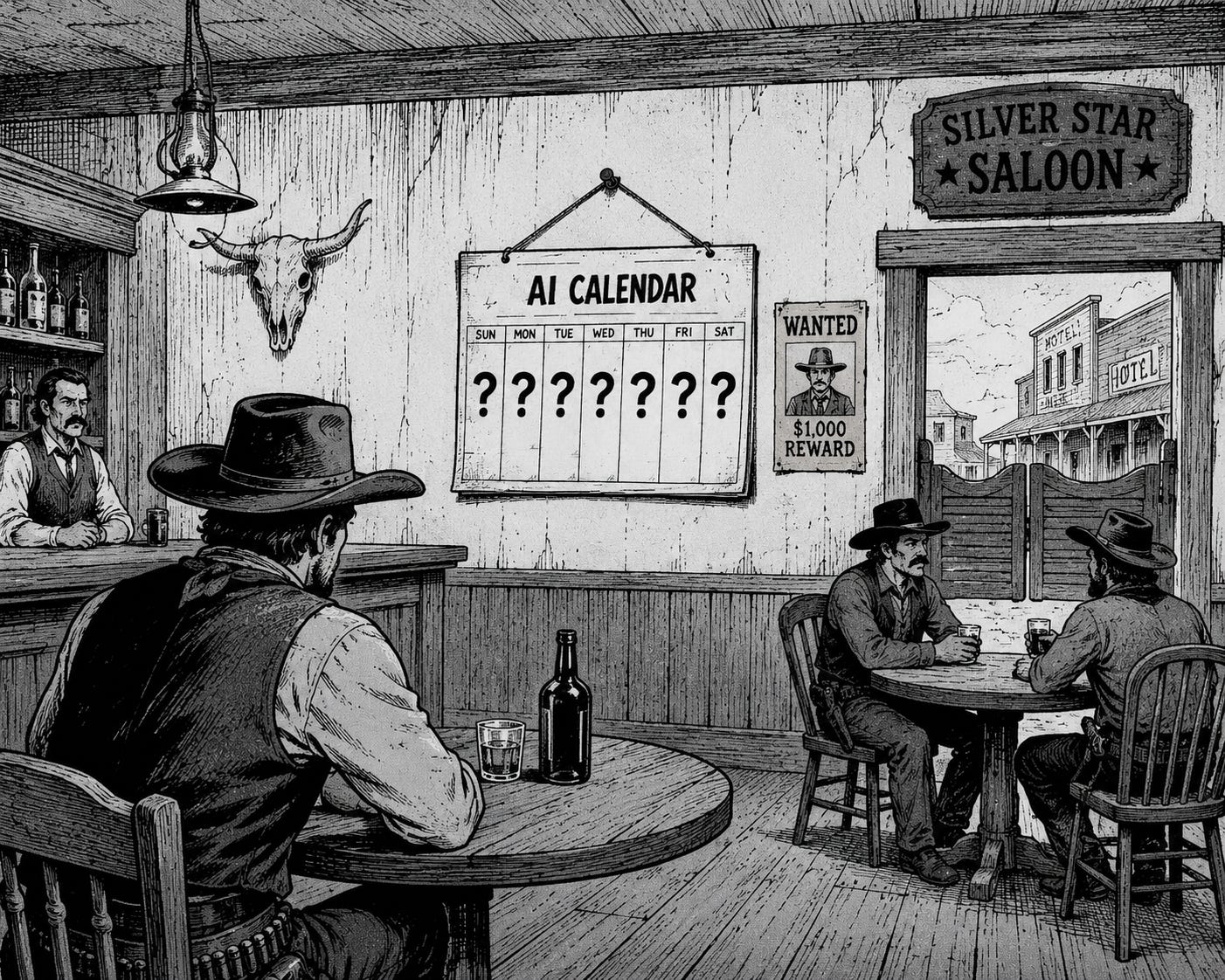
Black-and-white western comic-style illustration of an old saloon interior. Several cowboys sit at wooden tables drinking while a bartender stands behind the bar. Swinging saloon doors open to a dusty frontier street outside. On the wall hangs a large weekly “AI Calendar” with oversized question marks filling the days of the week, suggesting uncertainty about future plans. A cattle skull and wanted poster decorate the wall, all rendered in detailed ink linework and crosshatching reminiscent of classic western comics.
Uncertainty Saloon (Created with ChatGPT)

Meanwhile, the news cycle this week offered its own jagged edges.

A winner of the 2026 Commonwealth Short Story Prize has been accused of submitting an AI-generated story, and the situation quickly became a full-blown literary scandal. The accusations were amplified when Pangram Labs ran every Commonwealth Prize winner back to 2012 through their detection tool and found strong signals of AI-generated text in multiple entries, including the 2025 overall winner. The literary world, predictably, is having a moment.

And then Barnes & Noble CEO James Daunt appeared on the Today show and said he had no problem stocking AI-written books, as long as they were clearly labeled and not misrepresenting themselves. Cue the boycott calls. Cue the “all generative AI is ripping off someone else” counter-arguments on social media. Daunt has since clarified, repeatedly, that Barnes & Noble does not knowingly sell AI-generated books and takes active measures to exclude them. The clarification landed with about as much impact as you would expect, which is to say, not much. The outrage had already found its shape.

These two stories (the prize and the bookstore) are related. Both are really about thresholds. At what point does AI-assisted become AI-generated? Who gets to decide? What is the meaningful distinction between a human writer who uses AI as a tool and one who uses it as a ghostwriter? I do not have clean answers. What I am sure of is that any calls for no AI will just feed into shadow AI use.

On a more personal note: I have been noticing that when I write text on my own, without AI assistance, Grammarly flags it as AI-generated. (I still have a Grammarly subscription, though the controversy around the company has me reconsidering that). The flag itself made me stop and think. Am I absorbing AI patterns from all this use? Or is this a simpler and more uncomfortable explanation: that AI was trained on enormous quantities of mediocre writing (including mine), and is now reflecting the patterns of mediocre writing back at us, and Grammarly is simply recognizing them? I am a mediocre writer, so am I no better than AI?

I find this genuinely interesting and only slightly humbling.

Social media, that well-known venue for nuanced and measured discourse, has been full this week of a particular kind of certainty. The message, in various forms, is this: In five years you will look back and realize that AI in schools was a terrible mistake.

I do not know how to evaluate that claim, because I do not think anyone can know it. We are, as a society on the verge of something, but the outcomes are unclear. The people making this prediction with the most confidence tend to be the ones least encumbered by curiosity or evidence. As Ted Lasso misquoted “Be curious, not judgmental.” I think of Dave Fowler, sitting with his ChatGPT transcripts, genuinely wondering, and then I think of the social media certainty crowd, the UnDaves. The UnDave has an opinion. The UnDave does not let curiosity or facts complicate the opinion. The UnDave is very confident about what five years from now will look like.

I am not an UnDave. I hope I never become one. Here is where I am, for this week at least.

I love the exploration. I love what AI does for the scope and scale of what I can get done. And more than either of those things, I love that GenAI keeps opening doors to new questions, questions I would not have thought to ask, problems I would not have noticed, conversations like the one with Dave that I will be thinking about for weeks.

On schools specifically: I have said this before, and I will say it again. Caution is warranted. We do not have enough evidence yet about long-term impacts on learning, on writing development, and on productive struggle that builds capacity. Those concerns are legitimate and deserve to be taken seriously.

But on the other side of that, we must teach students about AI, what it is, how it works, and how it is changing the world they are growing up in. Not doing so is irresponsible. These students are going to live in a world shaped by this technology, whether we prepare them for it or not. Much like sex ed, if we don’t teach about it in schools, they will learn it elsewhere, with potential negative consequences.

I understand the desire to put the djinni back in the bottle. But we learned from the nuclear age that you cannot undo technologies. We must work as a society to reckon with the age of AI, and part of that is education.

Eric’s colleague used AI and did not know how to use it well. Dave used AI and understood enough to find the conversation genuinely interesting. The difference is not access. The difference is curiosity and intellectual engagement.

That is what education is (or at least should be).

Wednesday, May 20, 2026

Welcome to Summer!

 Summer School (The Good Kind)

Every year around this time, teachers start doing that particular mental math that only educators understand. How many days left? How many grades to enter? How many “are we doing anything today?” questions can one human absorb before the final bell? Summer is close, and the collective exhale is almost audible from here.

Most teachers I know fill that summer with a genuinely good mix of things: a conference or two, some professional reading they actually want to do, travel, family, and the radical act of sleeping past 6 AM. All of that is necessary and right. But I want to make a small case for adding one more thing to the list, and I promise it does not involve a syllabus or a rubric.

Get curious about GenAI.

Image Created with ChatGPT

Not in a high-stakes, district-mandate, someone-is-watching kind of way. Just curious. Summer is exactly the right time for this because the stakes are low. Nothing you try will scramble your fall classes. No 7:45 class depends on the quality of the output. You can experiment, fail, laugh at the results, and try again. That is almost never the condition under which teachers get to learn anything, and it is honestly the best condition for learning there is. Actually, the work we have done on ArtTEAMS grant for four years did exactly that each summer- but that is a story for another time. Although if you are interested our first publication just came out here.

Here are four things worth trying. These are just examples, feel free to riff…

Punch up an assignment you never had time to fix. We all carry them. The assignment that is fine, technically, but has been quietly bothering you for years because you know it could be better. Give a GenAI model the context, the learning objectives, and what you actually want students to get out of it, then see what it generates. I did this recently with an assignment where I always wanted students to think about instructional grouping using both assessment data and social and behavioral dynamics. I never had time to write meaningful student descriptions that would give the grouping decision real texture. This year I used GenAI to create those descriptions, and the assignment became substantially richer for it. The model did not replace my thinking. It handled the production work that had always been the obstacle.

Write a subject-specific AI policy. Counterintuitively, GenAI is quite good at helping you write a policy about GenAI. Start by feeding the model your district or institution’s existing policy, then describe the specificity and intentionality you want. I took this a step further and created differentiated expectations by assignment type: some asked students not to use AI at all, some encouraged proactive use, and some allowed it with disclosure. The clarity that came out of that process saved real class time and preempted a lot of the ambiguity that tends to eat up energy in the first weeks of a semester.

Make a document or presentation. The productivity tools built into or adjacent to GenAI have gotten genuinely good. I recently used one to produce a one-page project explainer that came out polished enough that I only needed to read and edit rather than draft from scratch. You still have to read it carefully and make it yours. But production time drops significantly, and for teachers who spend hours on materials that students may glance at for forty-five seconds, that math is worth considering.

Build a piece of software. This one surprises people, but it should not. GenAI is remarkably capable of creating small, functional, classroom-specific applications. I built an HTML-based reading fluency tracker that listens to a student read and another that scaffolds phonics practice. Both came out well beyond what I could have produced working alone, and neither required me to know how to code. The tools you actually want for your specific students, in your specific context, are more within reach than most teachers realize.

None of this requires a workshop. None of it needs to be assessed or reported. The only goal is to get your hands on the tools in a context where playing around is the whole point. That is how you develop genuine intuition about what these tools can and cannot do, which turns out to be far more useful than any training session.

So yes, go to the conference. Read the book. Take the trip. Sleep in. Spend lots of time with family and friends. Grill often. Drink occasionally.

And somewhere in there, try a few things. No pressure, no deadlines, no one watching. Just you, a curious question, and a summer with enough room to find out what happens. Or not, after all, it is up to you.

Monday, August 8, 2022

The Teacher Pipeline and TikTok

This weekend I dove into Teacher TikTok. It was fun and, at times, entertaining. I learned two things that are on the teacher's mind:

1. Requirements- for time beyond the contract, whether extending the school day, weekend or during unpaid summer time.

2. Professional development- the list here is even longer but can be summarized:

    Booking snooty speakers.

    The leaders of professional development are divorced from the reality in classrooms especially post-pandemic.

    Professional development that does not walk the talk.

    Professional development could be a video or email.

Professional development that does not consider the diverse needs of different teacher based on topic, experience and expertise.

Our professional learning in Art TEAMS is trying to provide an alternative that creates learning for teachers that is attentive to needs and presents new ideas but allow for time to process and design. We are focusing on respecting professionals and helping them achieve new things. However, I must also stress that everyone in our cohort chose to take this path. It follows that this work cannot be dictated and still expect to get the same outputs.


Sunday, February 2, 2020

Teaching as a Craft

Occasionally I browse the books available on audio from the library through my app and listen to an almost random pick. This is how I came by Eric Gorges’ A Craftsman Legacy. It turns out that the book emerged from a TV show with the same name. Eric reads a string of interactions with craftsman  while telling his personal story in a reflective measured voice. The result is almost hypnotic. What I found magical in the way Eric read his book was that it provided space to think. Eric who is a craftsman himself visits exceptional craftsman interviews them while learning to create in their medium. This allows for a conversation and a juxtaposition of a master, a novice, and the learning process.


I remember grappling with the conflicting ideas of teaching as an art or as a science. Following Eric’s argument I believe it is a craft and that the metaphors and rumination that emerge from the book can be useful when thinking about teaching. For example, Teaching curiously enough relies quite heavily on an apprenticeship model that Gorges sees disappearing in the physical crafts.

One strand that Gorges pulls as the book evolves is the notion of play. His interviewees often describe a path that starts in childhood, constructing a bow, taking a clock apart. But for them play never stops and the hours they put in make them an expert while keeping the element of play. As we recognize the role of play in encouraging curiosity and discovery I believe that exposing kids to physical crafts can be magical.

I have had the chance to visit with Justin Olmanson discussing his efforts to include Making in our teacher education programs. It seems like our students initially resist the effort required to actually iterate and make. The demand forces them to slow down and make time. What Justin says has helped is describing the emotional journey that accompanies making. In the same vain I wonder if we used craft of teaching as a guiding metaphor it would make it easier for our students to understand the iterative nature of learning to teach.

Tuesday, June 7, 2016

Notes from the Field- Technology Literacy and Art- Monique's Story

Monique and I go back a long time. She is one of my favorite teachers and one of the most thoughtful educators I have had the pleasure to work with. We have not worked together for quite a while but recently she sent me a short note on her work integrating technology so here it is in her own words (I took the liberty to make small changes for clarity).

Monique writes:
Earlier in the year I tried "tech buddies" -- a sixth-grade class & teacher graciously came to my room and worked with my students (I observed) in doing a little research, and each made a field-to-table Po
wer Point-type thing.   That was great, but a one-and-done experience because I only had access to the iPads for 40 minutes every other week. And I still had those mandatory tests/quizzes to work into my scheduled time!

My latest push of myself to use technology and use it a little more creatively started with a mask-making art project and the desire to get EL (and all kids) talking more in a purposeful way. I remembered that D. (1st grade ArtsLINC teacher) had her students successfully use a program/app called Chatterpix.  I had been introduced to Chatterpix by colleagues in the Nebraska Writing Project years ago,  but it had been shelved in my subconscious until this spring.   I had been talking with D. about iPad management (cart versus a few) and wondered how she did it. She told me how she has a small set of them in her classroom all the time (I  think 6) and teaches the kids how to manage and help one another.  She encouraged me that 'for sure' my second graders could make the masks talk with Chatterpix!  Then she told me how she had them post their work in an online journal called Seesaw.  She was making a believer out of me, but... I still felt like I needed a hand, a push or a kick --so --
I invited her over to our school site to provide an afterschool PD to our volunteer "Art PLC" to instruct us just in Chatterpix and Seesaw. (it was not a course in everything iPad, just two things!) Everyone was invited.  We had half-dozen teachers and our principal even came!    She not only walked us through using the apps but talked realistically about classroom management with young primary students.  She also made me realize I could probably do it with a few iPads and not a cart-full.  

So I checked out one (1) iPad from our principal and started in!   They photographed their mask.  They wrote a script for the speech that their mask would give.  (I had given them directions /ideas based on all the pre-learning before the Mask Making.). Then they recorded it using Chatterpix and uploaded it to their individual spot in our Classroom Journal I had set up on Seesaw.  They accessed Seesaw by using a QR code created by Seesaw when I signed up.  I taught two kids and then they managed the rest of the class!   When it was recording time they gave me a signal, then I just said "quiet on the set" and my class was immediately silent!  (they knew their turn was coming!)
The way Seesaw is set up, the teacher has to approve everything before it's posted, so that came after school.  Then -- my entry into integrating Art, Writing, Speaking, and Technology was successful!!

Seesaw also lets you invite parents to view just their child's portion of our class journal, so I did that and have several parents following their student's work now!  

Beyond this original project, I had kids use just Seesaw to take photos of their art and read what they wrote using the audio recording portion several times.  I video captured them reciting a poem of their choice.  They've given oral bi-weekly book recommendations (written first like a book report) all year, so I had them take a photo of their writing and accompanying art and audio-recorded their "speech."  In all cases, they could re-do if they reviewed-listened and weren't pleased.  

Student Masks (photo by Monique)
In the middle of our second "project", I invited the principal to come and see it in action-- with the kids doing it ALL!   I wanted to thank him for finding an iPad for me (my kids) to use and have available all day, every day.  He was as jazzed as I was.  He also saw that I was able to continue with MY passion of art and literacy integration (speaking, listening, reading, writing) and add technology and parent communication.     Within a few weeks, he asked if he could bring a group of principals into my room to see it in action.   THEN a week later he brought by a School Board member!   It was very affirming.   And even an old teacher like me can do it!
So next year, I'll be starting with Seesaw in the Fall to document & share most (if not all) of our ART & literacy (and social studies & science)  projects!    I'll still hang some on the classroom wall and in the office, but this will reach the parents much more quickly and is accessible to me in places other than my classroom!
Take care!

Monique

Saturday, May 14, 2016

3 Reasons Scaling Up Open Educational Resources Should be the Next Step


Open Educational Resources (OER) have been with us for over 20 years. The world wide web revolution made them accessible to anyone with an internet connection. The move in schools to 1 to 1 devices is making it possible now to rely on OER to replace curriculum companies. I believe that this is the time to scale the use of OER and move our schools boldly forward. I believe that the movement has matured enough to move from the periphery to the center of the education process. Here I outline the three most important reasons to do so.
  1.  It is democratic. Well vetted OER breaks the hold that publishers and some states (Texas, CA, NY) have had over the creation of materials. The use of OER allows districts, and potentially even teachers to exercise their professional judgment in curating the curriculum without having to create everything themselves. This will help build the professional capacity of educators to make decisions that fit the students and communities they are serving. The challenge here is tackling the potential for dealing with overabundance and the paradox of too much choice. To make this reality, a vetting process should be added to OER, so teachers have a sense of quality. Such curation is visible on sites such as OERCommons and ReadWriteThink.
  2. It is flexible. OER can be updated and corrected in real time without lengthy editing processes. In effect, we can use a Wikipedia-like process with super-editors who help maintain the integrity of the process. The value of OER is, therefore,  based on the quality of the original and the willingness of users to keep the resource updated and commented on. The use of crowdsourcing to determine the quality and maintain the "freshness" and accuracy of the information can be invaluable.
  3. It is (almost) free. Resources saved by not buying textbooks and teacher materials can be turned to making sure that schools have adequate technology infrastructure, adequate device distribution and most importantly- turn most of the savings into professional development that makes sure that teachers are well positioned to take advantage of the opportunity afforded by OER.