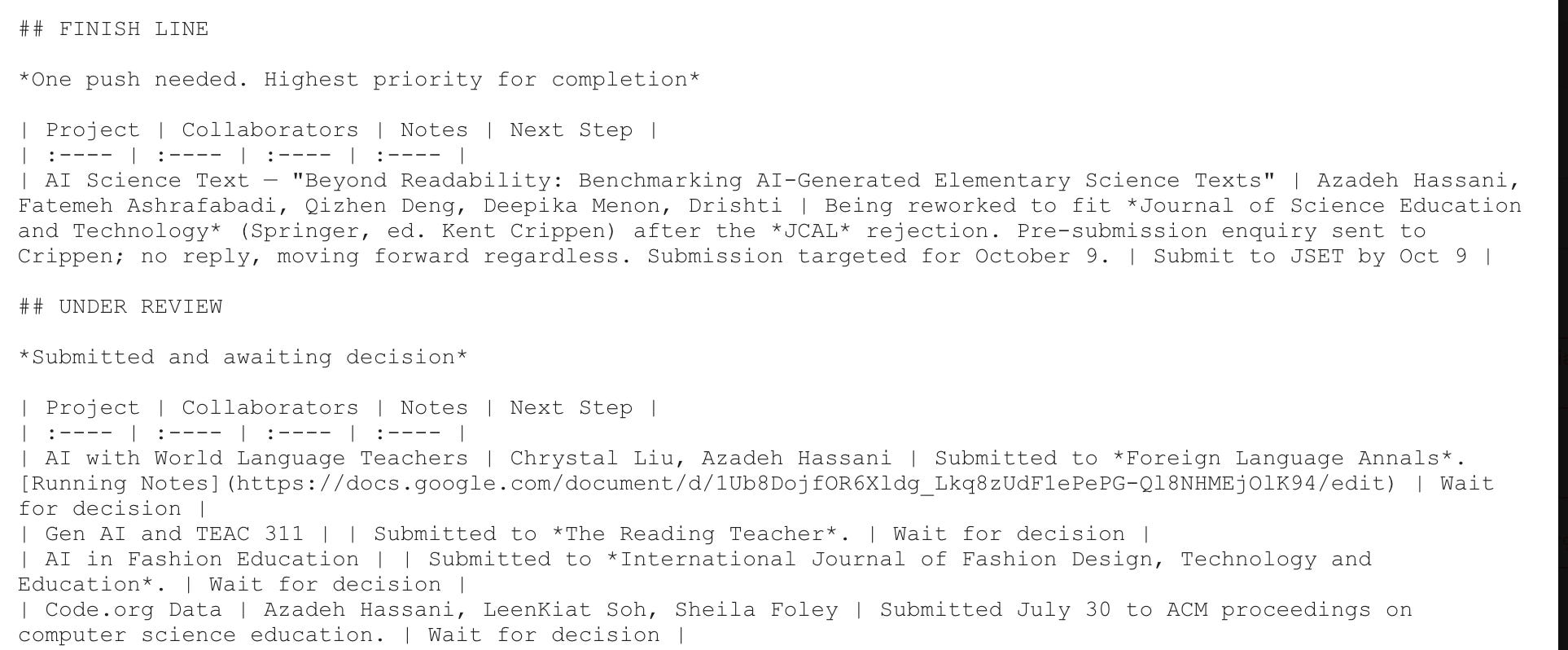
It is not a secret that I use AI, a lot. The most consistent use, though, is helping me manage all of my projects. I currently have over 15 research projects at different phases, from the idea stage through IRB, data collection, analysis, writing, and revising. I manage these projects and the next step in each using Claude, and I review them every Monday and Friday. On Monday I prioritize and set deadlines, and on Friday I update on progress.
This has changed my work significantly. Once a project makes its way into my AI workflow, I'm unlikely to forget it, and I am less haunted by the idea that I am forgetting something (what David Allen’s Getting Things Done calls open loops). It also allows me to have more projects, because I can manage more with my “digital brain.” Finally, AI helps me see which items I am ignoring. Right now I have a writing project about agency that has been dormant for 9 weeks, and my AI asked, is this still a project, or should I put it in a different category?
It reminded me of an idea Kathy Wilson and I discussed with the late Dave Brooks. At the time (over 20 years ago) he shared a writing support program he had created for students with learning disabilities. We put our heads together to see how we could improve it. The main idea was to develop a set of scaffolds for self-regulation of learning. The main challenge was are inability to have any meaningful way to differentiate for students and tailor it to the needs of the learner. The project never got off the ground, probably because both Dave and I had short attention spans and we just moved on. Now with AI agent in the mix I wonder if it is an idea worth revisiting
Screenshot of my Research Project Tracker
This weekend, I started thinking about how I manage my work against the backdrop of the rise of personal agents such as Meta’s Muse and OpenAI’s Dot. These agents are effective when they have context and access to our relevant data, including calendar, email, and other systems. It made me think that a good way to use AI for students would be a learning regulation agent. Imagine an agent that is connected to a student’s calendar, email (for messages from teachers and extracurriculars), and the LMS (learning management system) for assignment deadlines, tests, and even grades. That is the context the scaffolds Dave, Kathy, and I imagined never had.
The agent would be able to tell each student at the beginning of the week about major assignments and tests and help create a study plan, perhaps offering to create a practice test or index cards for studying. The possibilities are quite promising. For example, a teacher can give students 20 minutes on Monday to confer with their agent so they have an individualized learning plan for the week. On Friday, the agent can help students review what happened, which will help the agent understand what works for each student. Index cards may not help one student much, while practice quizzes with a timer really do.
In this way, each student would get occasional updates on which strategies work for them to accomplish goals, and be better prepared to meet challenges and plan well in the future. A scaffold is meant to come down, though. Two questions I am left with: first, how such an agent would hand the planning back to the student over time, or should we just assume that working with an AI agent to manage your study and work will be the way of the future; second, how do we make sure that the data is kept safely and without privacy concerns?
I apologize; I skipped a week of posting. It was my 60th birthday, and I was feeling existential angst. I had a topic ready, but when Sunday morning rolled around, I just could not bring myself to write. So apologies, but also maybe you had a few more minutes for yourselves, which is never a bad idea.
The topic I wanted to write about last week is the peculiar situation that is uniquely American. Older Americans see AI more positively than younger generations n(though not be much). My inquiry into this issue began when I had a chance encounter with a colleague who retired quite a few years ago; after recognizing me, he excitedly said he would love to meet and talk about AI. A few months ago, I shared about another former colleague who wanted to share and learn about what we were doing and thinking. At the same time, many of my colleagues and quite a few of my undergraduate students react with resistance, which I accept, but also an emotional response that is hard to process. So, older pAmericans were welcoming and younger ones rejecting AI. I wanted to know if my anecdotal data collection was backed up with more data. It turns out this is a trend that the Pew and others have noted in large scale polling.
This is hard to disentangle because this is not universal. International data shows a more familiar trend, with younger people more excited and positive about AI. I believe that the reasons are complex and multi-layered, including our disillusionment with the Tech industry, especially social media, and our rising environmental concerns. This may be uniquely American because the companies driving this change are US (and Chinese) companies, and we feel we should have a stake and a say, whereas the rest of the world lacks that sense of agency. This is not my point though.
In multiple conversations with colleagues exploring this world of AI and its impact, I heard frustration and a sense of foreboding. We are becoming reluctant to talk about our work because we do not wish to be the subjects of an emotional response or get drawn into an argument. The cost of talking about AI is rising, and it is impacting our ability to talk about what the field is experiencing.
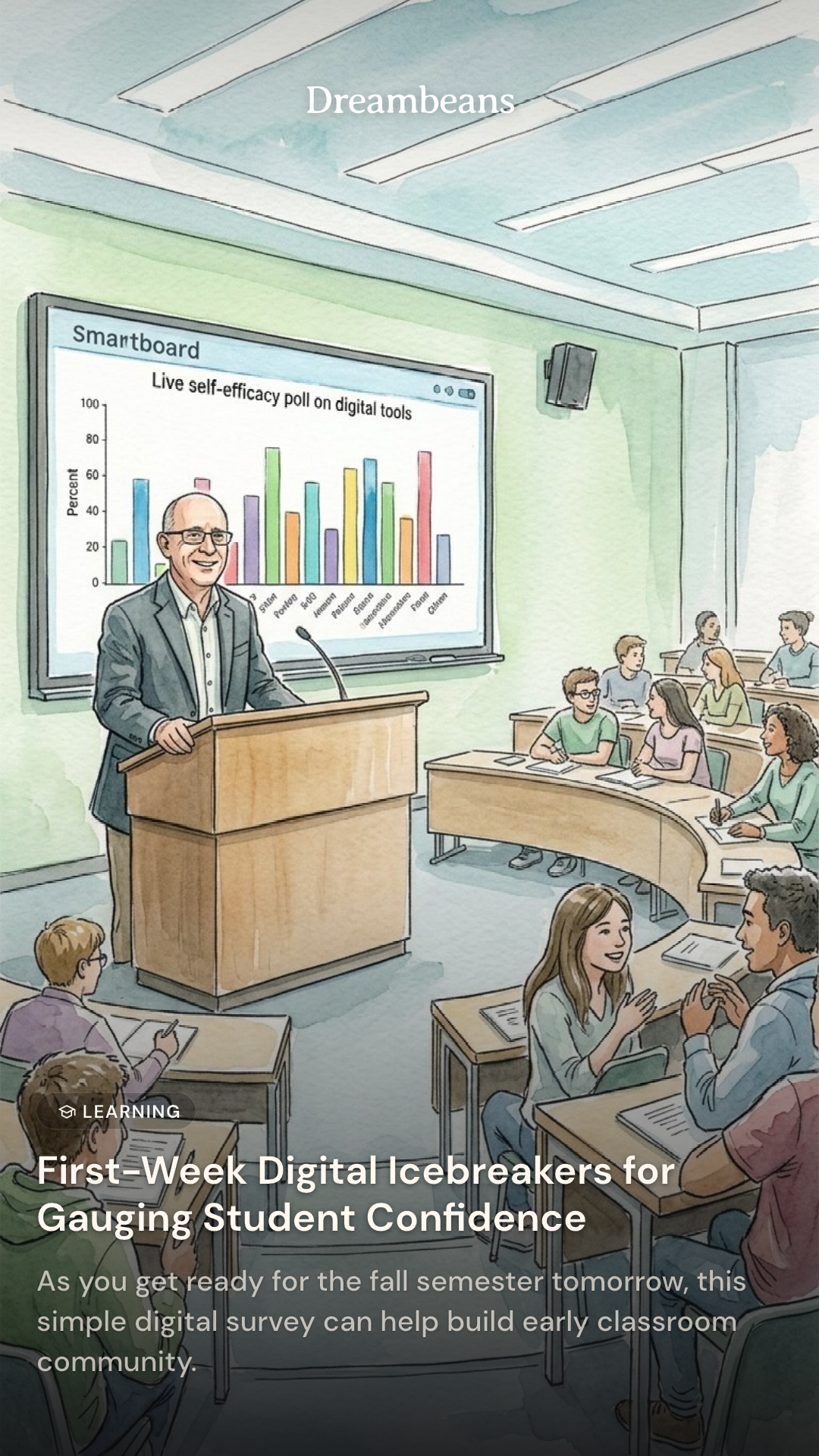
From Gemini Dreambeans App
This brings me to the beginning of the semester. I am teaching a class about technology integration. AI must have a seminal presence in that class. I found myself dreading broaching the subject with my students. This dread is useful because it makes me more deliberate and thoughtful about the scaffolds and exit ramps I put in place. I must open the world of AI to my students; it will be their world, and if they choose to reject AI, I want them to do so from a place of understanding and acknowledgment of the tradeoffs. The cost of that silence may be too high as we prepare professionals who will not be able to face the moment, who will not be able to prepare their students for a world where AI in everywhere and expected.
SO I will get over myself and introduce AI its advantages and concerns throughout the curriculum. Wish me luck!
This week I had the opportunity to spend two days with the combined teams from ISTE and Google with fifty or so colleagues from all around the country thinking about AI in higher education. This was in my top two professional development experiences for working with AI, and it has changed my opinion of using Gemini in higher education.
The PD started with NotebookLM (now Gemini Notebook). As I watched it I had a sinking feeling that this PD, much like a few others I had in the last few months, would stay at the ground floor of capabilities. I was wrong. In the following sessions, the team was wise enough to divide us by level of comfort with AI for some activities, while in others we worked based on interest in a theme or the point our institution was on a developmental path toward AI readiness.
As always the conversations around the tables with different themes were enlightening. I worked side by side with plant researchers, law school instructors, computer science professors and student support professionals. I learned something from each and I hope I was able to contribute.
The discussion and use of Gemini trying to solve the problem of supporting my peers on their AI journey was fascinating. Last year, a colleague and I created the CEHS AI circles, trying to respond to faculty's call for opportunities to learn. We held a session every Friday for a full academic year but had very limited success attracting participants. We did have 4-10 people every time (more staff than faculty), but very little experimentation and actual work. This was a great opportunity to use my time with prompt suggestions from the PD team to explore the issue further.
So I gave Gemini the framework of the situation, not just AI but also about our budget cuts, new interim Dean and the general mood as I read. Gemini gave me what I regarded as soft language so instead I asked for a hard look. This is what I got:
The Raw Truth About Your Faculty Problem
The “Nobody Gives a Shit” Frame: Let’s stop sugarcoating it. Your faculty aren’t showing up because they fundamentally do not care about your well-structured, low-barrier, kumbaya professional development. To them, it’s just another useless pile of crap on a plate that is already overflowing. “Voluntary” doesn’t mean low-pressure; it means “optional bullshit I’m going to ignore so I can survive the week.”
The Paranoia and Cynicism Frame: The atmosphere is choking on toxic, “negative vibes” and bitching about AI is currently the easiest way for faculty to deal. Walking into an AI workshop feels like walking into a trap where they have to admit they’re lost, or worse, risk getting side-eyed by their peers for drinking the tech Kool-Aid.
The Bureaucratic Middle-Finger Frame: You want leadership to give you a golden ticket—sanction without sounding like a mandatory “do more with less” beatdown. But let’s be real: administration is terrified, budgets are bleeding, and faculty are already convinced any top-down tech initiative is just a Trojan horse to squeeze them harder or make their jobs obsolete. Until you stop treating time like a magical, flexible resource that they can just “carve out” of their already-shattered schedules, you’re just screaming into an empty room.
As always, when asking someone for a raw, unfiltered opinion, it can be challenging to read and process. It is also a reminder that it might not be true. That said I believe it is more true than not. So what I asked: can I do as a faculty member who wants to support others WITHOUT creating mandates, keeping it voluntary, and remembering that I am NOT in a leadership position.
This is what Gemini Suggested:
The “Trojan Horse” Relief Trap (Zero-Effort Utility)
Forget workshops, open PD, and “AI literacy.” Faculty don’t want to learn how to prompt; they want their worst, most mind-numbing administrative chores to magically disappear.
The Move: Bypass the “learning” phase entirely. Do the work for them behind closed doors, or set up a high-yield, done-for-you swap.
The Execution: Instead of advertising an AI session, announce: “Send me your ugliest, most time-consuming rubric, your messiest qualitative student feedback data, or your most tedious syllabus policy update, and I will hand it back to you restructured and optimized by Friday.”
Why it works: It shifts the value proposition from “come do extra work” to “let this tool steal a miserable chore off my plate.” Once they see a tangible artifact built specifically for their class that saves them three hours, the conceptual resistance starts to crack.
It makes sense to me, and I am going to try a version of it. A 15-minute tool demo followed by a sample solution to somebody’s real problem. I will let you all know how this works.
The Nebraska Council of School Administrators puts on a summer event before school starts called Administrator Days. This year, for the third year in a row, I joined the conference, this time for just one day. I heard a lot about reading, changes to CTE, law, and behavior, but almost nothing about AI. Now, the Nebraska Department of Education and the ESUCC put together one session on the unified approach to Tech, including AI, and did an amazing job. But that was it. I tried to dig through the program and find a significant representation for this thing that is looming over us and disrupting our business as usual. Crickets.
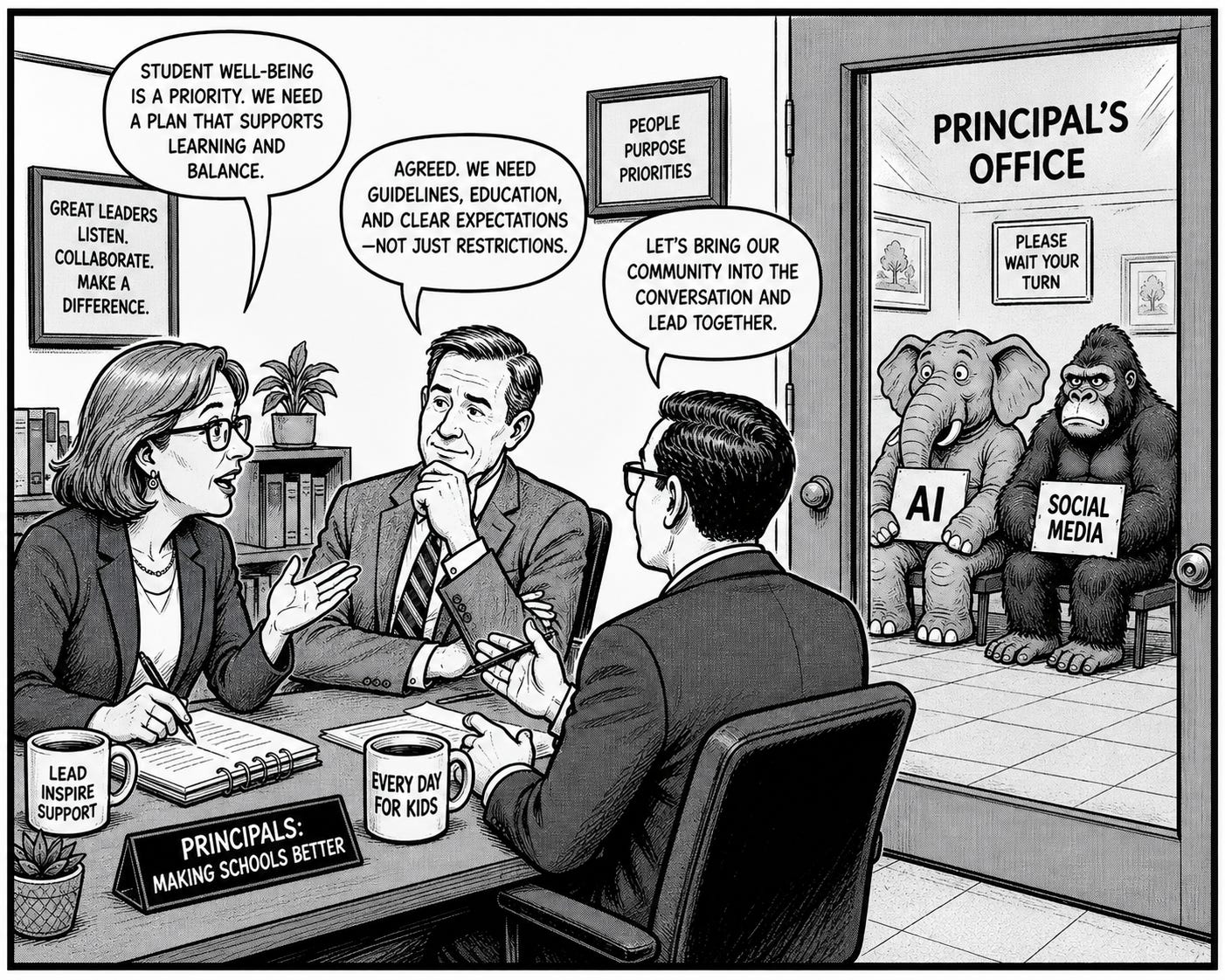
This is the elephant that isn’t in the room, the gorilla that was not invited, and whatever other metaphor you would like to have about ignoring a real problem.
Crickets.
I am of two minds here. Reading is still important, maybe more than ever. Focusing on basic skills and making sure our students are ready to tackle any and all academic work through this medium is important, mission-critical, crucial. Hell, I was trained as a professor of literacy and taught reading to students of all ages with a reading disability. Yes it is VERY important. So maybe, we should talk about it with our leaders. I actually love the focus from the deprtment, that says no matter
But the relative silence about AI. Not just in the room and the program but in the corridor conversations, hit me hard. AI is here; it is changing classrooms, learning, and what our students can and will do with or without permission. Most districts in Nebraska have adopted legal language around AI, warning against unethical use and making AI policy a topic for teacher decisions. In essence, school systems are making it teachers’ problem.
So the positive spin on the lack of conversation around AI is that our schools are not being distracted by this shiny new thing. They need to improve what they are doing for every student at any age. I am all in for focusing on what students need. Another reason can be that we need to wait for this innovation to settle before we do anything about it.
The not-so-positive look is that schools, through their leaders, are sending a message that this enormous change that is sweeping through society and is now available to any student who has access to the internet, is not a big deal. Is this the right message?
My fear is that, by ignoring the reality forming on the ground, administrators are abandoning teachers to figure it out on their own, as the policy itself says. I actually love giving teachers agency, but at the same time you need to give them tools and force the issue. I want every Math teacher to know there is an app that allows students to upload any assignment and get the answer step by step. I want them to think about adjusting the way they do business BEFORE they catch the first student “cheating”. It’s not enough to say every teacher can create policy in her classroom. Give them some tools, quickly, before we have another completely avoidable crisis with discouraged teachers and students who are not spending enough time in the friction of learning.
I hope I am wrong and everything is going to be great; AI is going to be a non-event for education. But since I am right now in Chicago trying to learn further about it- you know where I stand.
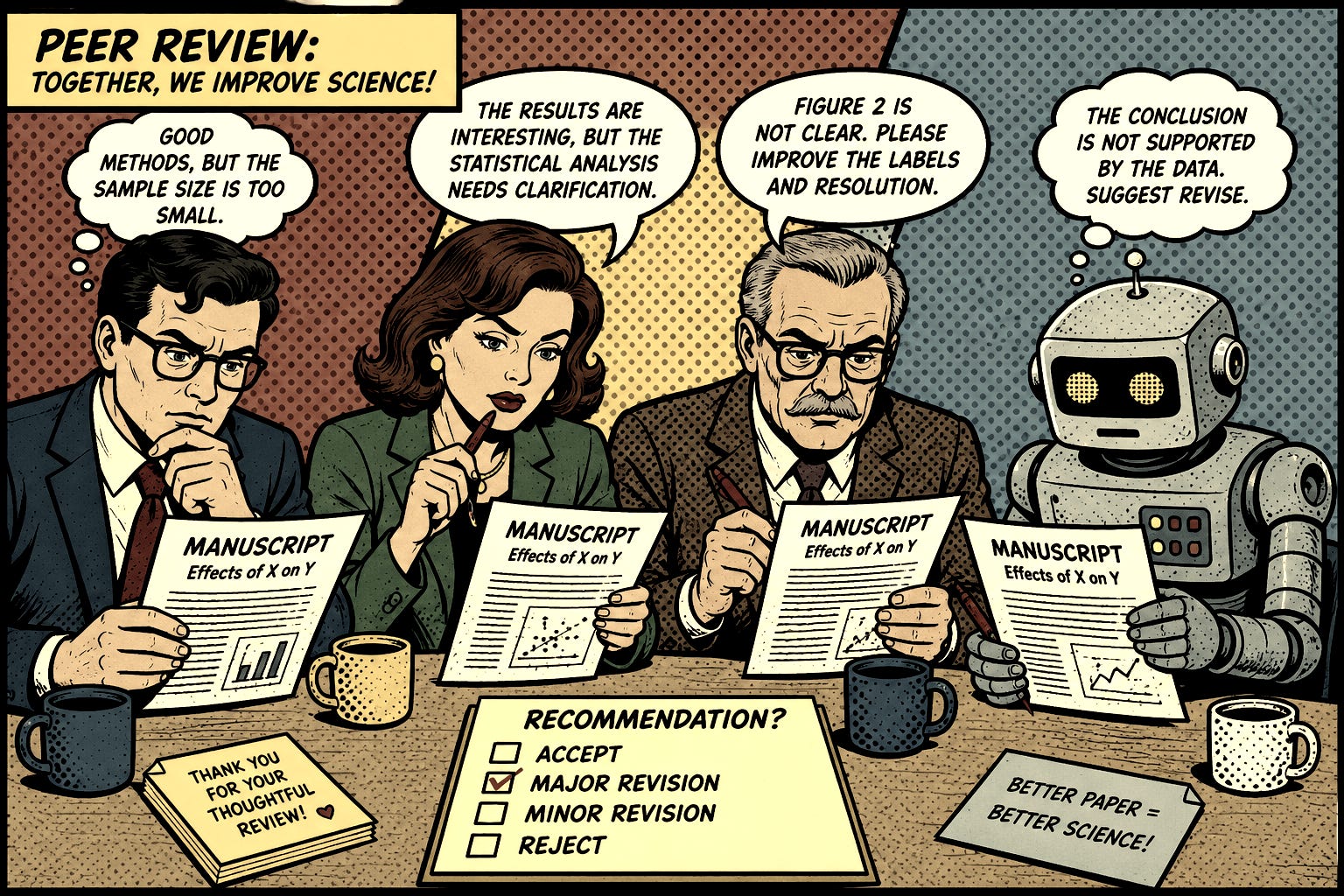
It’s summer, and I finally have a bit more breathing room, some of which I use for peer review (the rest is for my granddaughter). The pressure never really lets up, though. I’ve written before about how AI is reshaping that pressure, on both the writing and reviewing sides of the equation.
Publishers are drawing a clear line. They’re asking reviewers not to run submitted manuscripts through AI tools, and they’re right to ask. A paper under review is unpublished work. Feeding it into a commercial AI system risks the author’s intellectual property in ways reviewers might not stop to consider.
I follow that line carefully. I use AI to help me write up my reviews, sharpen the language, organize my thoughts, and make the feedback easier for authors to act on. I never run a manuscript I’m reviewing through AI, though often I think it could help.
I know it could be helpful because with my own writing I do something different. When I finish a draft, I ask AI to act as a peer reviewer and pick apart my argument. Where is it weak? What can I cut when I’m over a word limit? AI has been remarkably good at both. It catches gaps I’ve stopped seeing because I’ve read my own draft too many times. I get back to work the same way I would after an actual peer review, provided I agree with the notes, which, much like human reviewers, I do not have to agree with.
I do this through institutional AI that doesn’t train on what I feed it. I’ll admit, honestly, that the training question isn’t the part that keeps me up at night, even if I did not have such access; the benefits definitely outweigh the risks. What strikes me instead is how good the feedback is and how much better the review process could be if this kind of access extended to reviewers too.
I’m not calling for AI-written reviews- in that case humans are not needed. I want to be clear that we (still?) need human reviewers. What I’d love to see is publishers giving reviewers access to no-training AI as a tool.
Peer Review made with ChatGPT 5.5
Picture a reviewer working through a manuscript that cites a document by name. Right now, chasing that down means opening another tab, another search, another interruption. AI access built into the review platform could pull it up on the spot. Or picture a paper built on a statistical test with a dozen parameters. A reviewer could ask what those parameters mean and whether they were applied correctly, instead of taking the authors’ word for it or quietly moving past a section they don’t fully trust but have no time to verify.
I recently reviewed a paper where the data looked suspect. It was disappointing, and in that case, the signs were obvious enough to catch without much effort. But it left me wondering how many more subtle cases slip through, the ones that look clean on the surface and only fall apart under closer inspection. That’s exactly the kind of pattern-checking AI does well, if reviewers had a legitimate, secure way to run it.
The bigger opportunity is replication. Right now, a reviewer can, in principle, rerun an analysis or test an alternative approach if the authors shared their data. In practice, very few do it, because it takes far more than any reviewer has the time and resources for. AI with real document and data access could shrink that gap. Reviewers could actually check the math (within approximation) instead of trusting that it holds. This may be critically important when people are using AI to generate research facsimiles, sometimes fabricating the data and the writing.
None of this changes what a peer reviewer is for. The job is still to weigh the argument, judge whether the evidence supports the claims, and tell the editor whether the work deserves to move forward. AI wouldn’t replace that judgment. It would just let reviewers exercise it with more precision, on more of the paper, in less time.
Faster reviews. Sharper reviews. Reviewers who can actually verify instead of just trusting. That seems like a use of AI worth building, and one publishers are well positioned to build safely, since they control the data and access.
I started this week sitting across from a long-time colleague, someone whose work I respect and whose judgment I trust. Let’s call him Eric. Eric is co-authoring something with a younger scholar, and he has been finding hallucinated references in the manuscript. He has, I think, tacitly accepted that AI was used in the writing. The references are the tell. He has not said so explicitly, but the evidence is sitting right there in the reference list.
What struck me about the conversation was not the hallucinations. Those are a real problem, and anyone using AI-assisted writing needs to know that. What struck me was that Eric is not using AI himself, which means his mental model of the technology is frozen at whatever he last heard about it. He does not know yet that frontier models (the current generation) are substantially less prone to fabricating citations than earlier versions. His experience of the technology is secondhand and dated, and that gap between perception and current reality is itself a kind of problem. The tool is a moving target, and the critique needs to move with it.
Later in the week, I had a completely different kind of conversation. Dave Fowler, a math education professor who retired a few years ago, shared with me the exchanges he has been having with ChatGPT about the nature of theories. Dave is curious, playful even about what this thing is and what it can do.
He shared some of the thinking he was doing with and about AI. We smirked together at the turns of phrase the model deployed in those conversations, including things like “You’re drawing a very precise and interesting analogy, Dave.” which my brain heard in the voice of HAL 9000. There is something both charming and slightly unnerving about that sentence. It flatters, it redirects, it sounds like a thoughtful interlocutor. Is it? Is it not? Dave was not sure, and neither was I, and that wondering felt like the right place to be.
I am still turning that conversation over in my head. What Dave is modeling is something I think we are not talking about enough in education: what it looks like to approach AI with curiosity rather than with a verdict already in hand. He retired, he has no institutional pressure either way, and for $20 a month he is just... exploring. There is something intellectually honest about that.
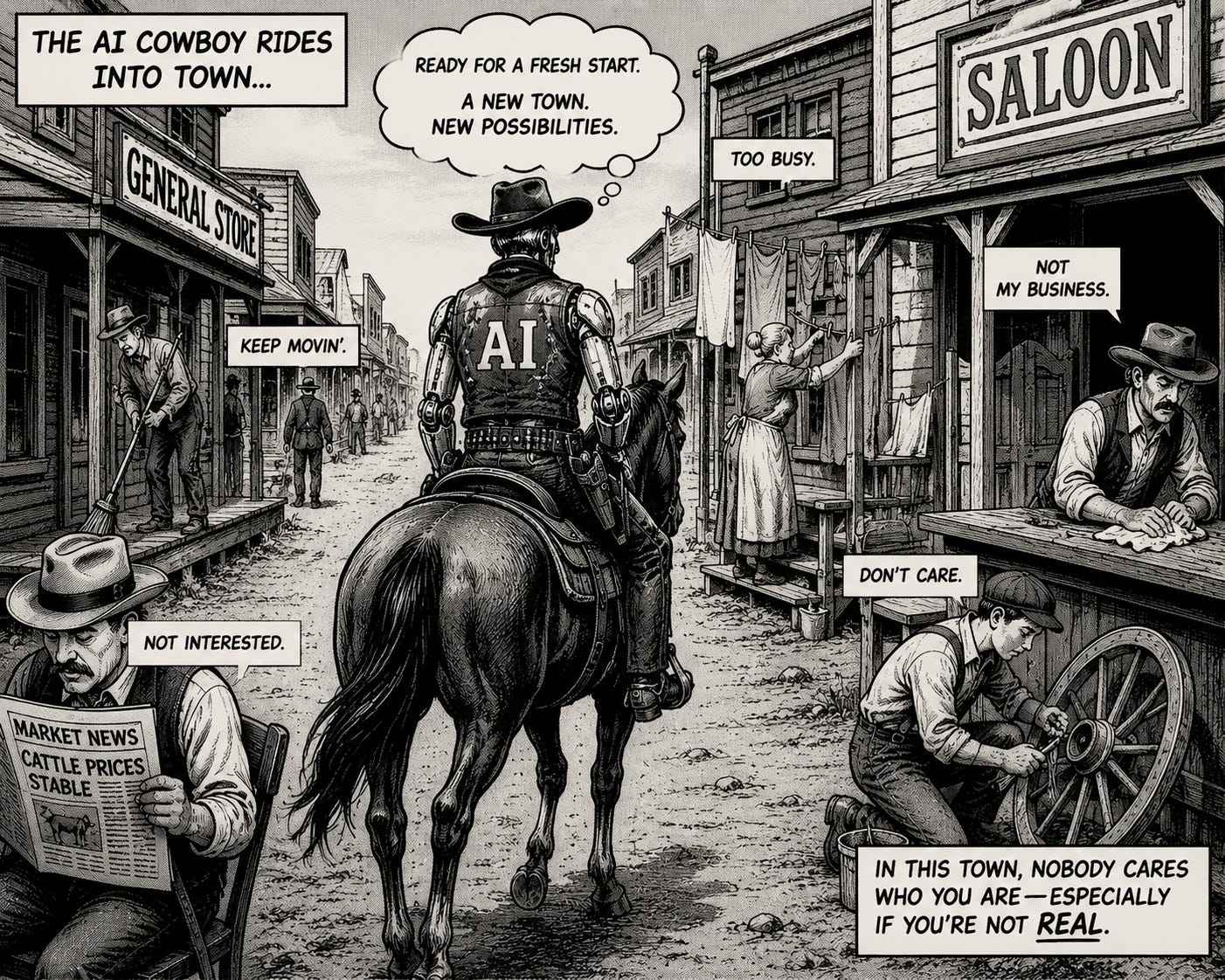
Uncertainty Saloon (Created with ChatGPT)
Meanwhile, the news cycle this week offered its own jagged edges.
And then Barnes & Noble CEO James Daunt appeared on the Today show and said he had no problem stocking AI-written books, as long as they were clearly labeled and not misrepresenting themselves. Cue the boycott calls. Cue the “all generative AI is ripping off someone else” counter-arguments on social media. Daunt has since clarified, repeatedly, that Barnes & Noble does not knowingly sell AI-generated books and takes active measures to exclude them. The clarification landed with about as much impact as you would expect, which is to say, not much. The outrage had already found its shape.
These two stories (the prize and the bookstore) are related. Both are really about thresholds. At what point does AI-assisted become AI-generated? Who gets to decide? What is the meaningful distinction between a human writer who uses AI as a tool and one who uses it as a ghostwriter? I do not have clean answers. What I am sure of is that any calls for no AI will just feed into shadow AI use.
On a more personal note: I have been noticing that when I write text on my own, without AI assistance, Grammarly flags it as AI-generated. (I still have a Grammarly subscription, though the controversy around the company has me reconsidering that). The flag itself made me stop and think. Am I absorbing AI patterns from all this use? Or is this a simpler and more uncomfortable explanation: that AI was trained on enormous quantities of mediocre writing (including mine), and is now reflecting the patterns of mediocre writing back at us, and Grammarly is simply recognizing them? I am a mediocre writer, so am I no better than AI?
I find this genuinely interesting and only slightly humbling.
Social media, that well-known venue for nuanced and measured discourse, has been full this week of a particular kind of certainty. The message, in various forms, is this: In five years you will look back and realize that AI in schools was a terrible mistake.
I do not know how to evaluate that claim, because I do not think anyone can know it. We are, as a society on the verge of something, but the outcomes are unclear. The people making this prediction with the most confidence tend to be the ones least encumbered by curiosity or evidence. As Ted Lasso misquoted “Be curious, not judgmental.” I think of Dave Fowler, sitting with his ChatGPT transcripts, genuinely wondering, and then I think of the social media certainty crowd, the UnDaves. The UnDave has an opinion. The UnDave does not let curiosity or facts complicate the opinion. The UnDave is very confident about what five years from now will look like.
I am not an UnDave. I hope I never become one. Here is where I am, for this week at least.
I love the exploration. I love what AI does for the scope and scale of what I can get done. And more than either of those things, I love that GenAI keeps opening doors to new questions, questions I would not have thought to ask, problems I would not have noticed, conversations like the one with Dave that I will be thinking about for weeks.
On schools specifically: I have said this before, and I will say it again. Caution is warranted. We do not have enough evidence yet about long-term impacts on learning, on writing development, and on productive struggle that builds capacity. Those concerns are legitimate and deserve to be taken seriously.
But on the other side of that, we must teach students about AI, what it is, how it works, and how it is changing the world they are growing up in. Not doing so is irresponsible. These students are going to live in a world shaped by this technology, whether we prepare them for it or not. Much like sex ed, if we don’t teach about it in schools, they will learn it elsewhere, with potential negative consequences.
I understand the desire to put the djinni back in the bottle. But we learned from the nuclear age that you cannot undo technologies. We must work as a society to reckon with the age of AI, and part of that is education.
Eric’s colleague used AI and did not know how to use it well. Dave used AI and understood enough to find the conversation genuinely interesting. The difference is not access. The difference is curiosity and intellectual engagement.
That is what education is (or at least should be).