Showing posts with label edtech. Show all posts

Sunday, August 30, 2026

I don't bike to biking group: Grappling with Ai contradictions

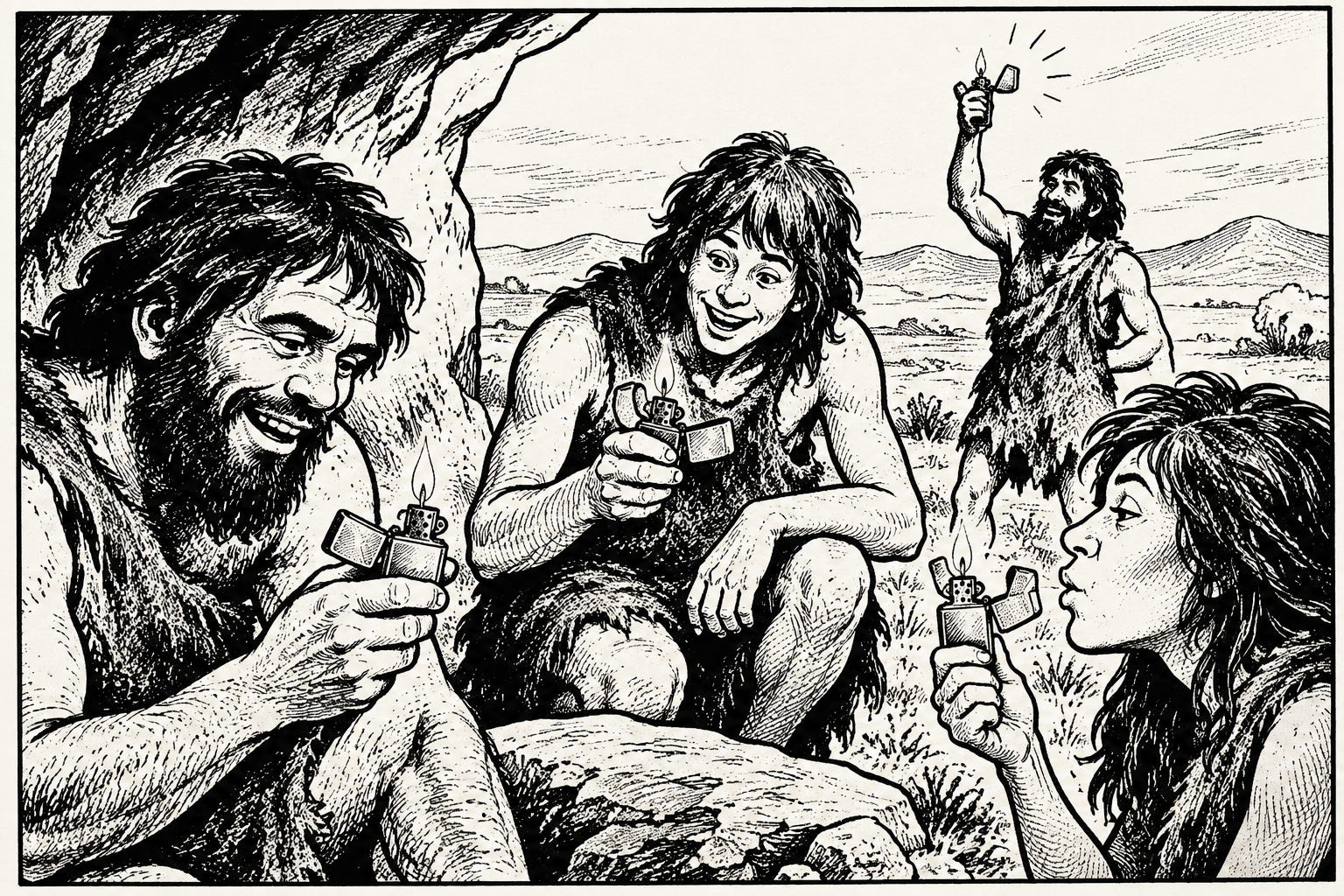
 I am heading out, as I do most Sundays, to meet with the biking group. No, I don't bike; more than that, I don't want to be judged for joining a biking group coffee conversation without having biked there. I love solving the world’s problems before noon and then returning to my everyday life having had a meaningful, even joyful interaction, without biking.

Why am I sharing this? I have been thinking about the backlash against (and shaming of) AI-generated everything, but most prominently, writing. I want to be judged by the quality of my ideas, the clarity, and the flow of what I want to say. Just like I want to show up for the biking group not having biked, without judgment. When I read AI, it is the same; I do not want to care if it was generated (or smoothed) by AI; I want to care about the content and the ideas.

The truth is that it takes discipline. There is ample work that shows that AI users are better at spotting AI writing. I am not sure I am better than average, but there are cases when I am quite sure that I am reading AI. Notice I did not say AI slop, just AI. And that is the distinction for me: slop is slop whether AI-generated or not.` Coherent arguments are coherent regardless of authorship.

What I noticed, especially when I do peer reviews, is that I have an instinctive reaction to writing that strikes me as Claude-ish (or AI-ish). My bias translates to: “if you asked AI to write this, why did you ask me to read this? Why should I care?” This has also been documented as the AI tax: people devalue what they perceive (accurately or not) as a product of AI. As with other cognitive biases, I have to use metacognitive strategies to shape the bias and ask the more substantive question. What is the merit of the argument? What does it add to our scientific knowledge? Where can it be better. The biggest challenge may be that cognitive biases are notoriously hard to shake. Kahenmann said: “This is the essence of intuitive heuristics: when faced with a difficult question, we often answer an easier one instead, usually without noticing the substitution.”
Daniel Kahneman, Thinking, Fast and Slow

Few of us are immune to this blind spot. In the case of AI I am painfully aware that dismissing AI is a lazy heuristic but that does not make it much easier to overcome. I make a special effort to work through the text and get to the heart of the argument.

Notice I am not claiming that AI text is better. In fact, I believe it is often worse because it tends to use expected but dense language. The point is that I need to judge it on its own merit without considering the source.

This argument does not hold in education. In my classes, I am teaching students to think, and so evaluating the argument made by AI is irrelevant; the point was to teach humans to think. This makes AI a much more nuanced partner. In science, the only question is whether science has moved forward; in training teachers, the question was whether they developed the discernment and capacity.

The education part requires more thought (or so Claude has informed me) but I am off to meet the bike group.

Monday, August 3, 2026

Elephants, Gorillas, No AI: Thoughts from a day spent at Nebraska Administrator Days

 The Nebraska Council of School Administrators puts on a summer event before school starts called Administrator Days. This year, for the third year in a row, I joined the conference, this time for just one day. I heard a lot about reading, changes to CTE, law, and behavior, but almost nothing about AI. Now, the Nebraska Department of Education and the ESUCC put together one session on the unified approach to Tech, including AI, and did an amazing job. But that was it. I tried to dig through the program and find a significant representation for this thing that is looming over us and disrupting our business as usual. Crickets.

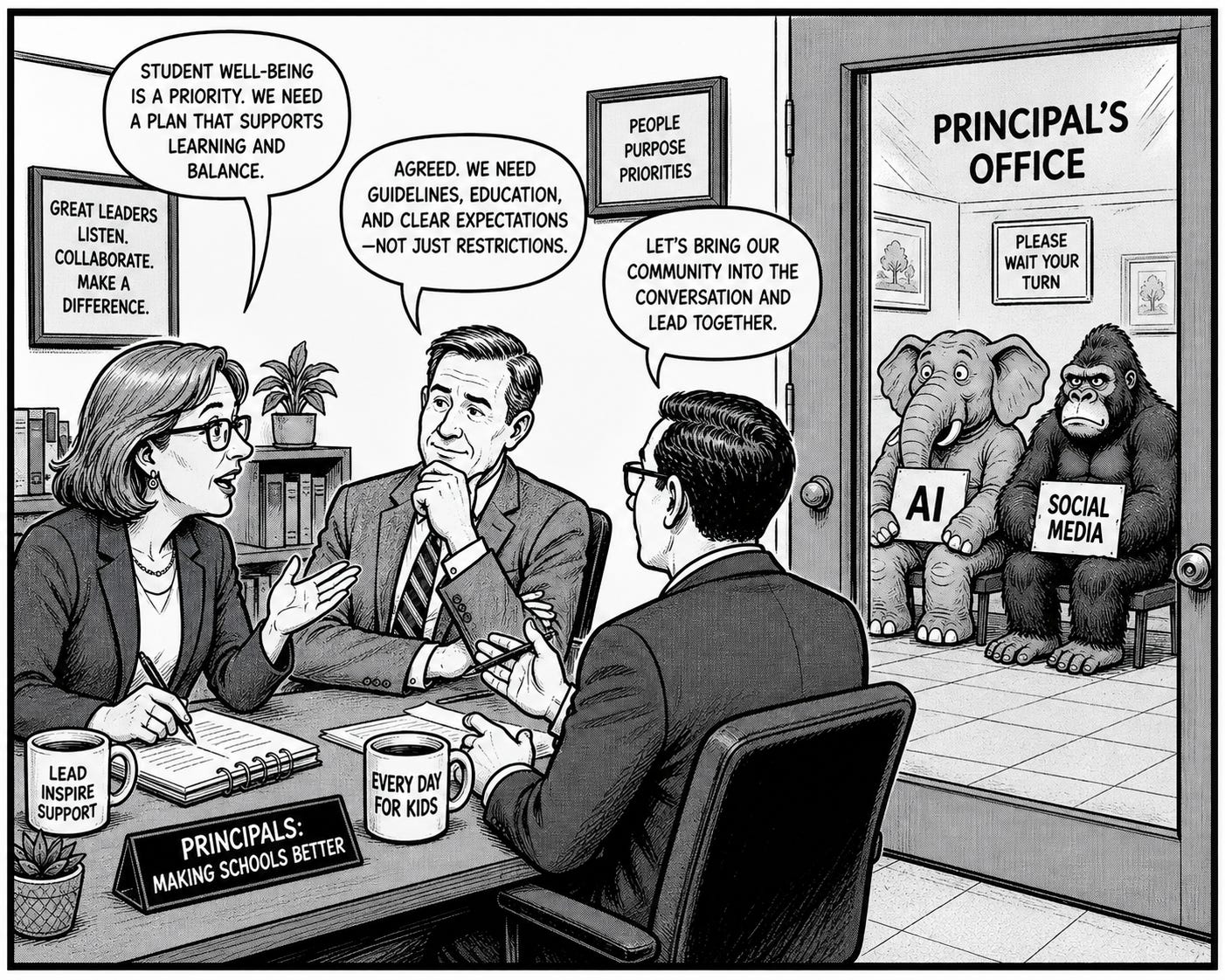
This is the elephant that isn’t in the room, the gorilla that was not invited, and whatever other metaphor you would like to have about ignoring a real problem.

Crickets.

I am of two minds here. Reading is still important, maybe more than ever. Focusing on basic skills and making sure our students are ready to tackle any and all academic work through this medium is important, mission-critical, crucial. Hell, I was trained as a professor of literacy and taught reading to students of all ages with a reading disability. Yes it is VERY important. So maybe, we should talk about it with our leaders. I actually love the focus from the deprtment, that says no matter

But the relative silence about AI. Not just in the room and the program but in the corridor conversations, hit me hard. AI is here; it is changing classrooms, learning, and what our students can and will do with or without permission. Most districts in Nebraska have adopted legal language around AI, warning against unethical use and making AI policy a topic for teacher decisions. In essence, school systems are making it teachers’ problem.

So the positive spin on the lack of conversation around AI is that our schools are not being distracted by this shiny new thing. They need to improve what they are doing for every student at any age. I am all in for focusing on what students need. Another reason can be that we need to wait for this innovation to settle before we do anything about it.

The not-so-positive look is that schools, through their leaders, are sending a message that this enormous change that is sweeping through society and is now available to any student who has access to the internet, is not a big deal. Is this the right message?

My fear is that, by ignoring the reality forming on the ground, administrators are abandoning teachers to figure it out on their own, as the policy itself says. I actually love giving teachers agency, but at the same time you need to give them tools and force the issue. I want every Math teacher to know there is an app that allows students to upload any assignment and get the answer step by step. I want them to think about adjusting the way they do business BEFORE they catch the first student “cheating”. It’s not enough to say every teacher can create policy in her classroom. Give them some tools, quickly, before we have another completely avoidable crisis with discouraged teachers and students who are not spending enough time in the friction of learning.

I hope I am wrong and everything is going to be great; AI is going to be a non-event for education. But since I am right now in Chicago trying to learn further about it- you know where I stand.

Friday, March 27, 2026

The Jagged AI Frontier in Schools

Last week I joined a presentation on AI in education. During Q&A, a student asked what I thought was the most grounded question of the session: what is actually happening in K-12 schools right now? How are they responding?

It is a question I get a lot, and I find that my answer keeps getting cleaner the more I chat with schools.

Ethan Mollick’s concept of the “jagged frontier” was built to describe what AI can and cannot do, but I think it applies just as well to how schools and school systems are navigating AI. The response is uneven, messy, and genuinely interesting to watch. After working across a range of systems in the US and paying close attention to what is happening globally, I see four distinct patterns.

All-In

Some school systems and even entire countries have decided to ride the wave as a matter of national agenda. Singapore is the clearest example, treating AI integration in education as a strategic priority rather than something to manage or contain. Its EdTech Masterplan 2030 lays out a whole-nation vision for what it means when a government decides to lead rather than follow. China has taken a similar posture, although the size and complexity of its educational system make it internally jagged. South Korea went all-in early; and has since pulled back in striking fashion, which is its own fascinating case study in what happens when adoption outpaces readiness. The AI textbook rollout stalled at around 30% adoption, became politically polarized, and was ultimately reclassified as optional after less than a semester. Worth watching closely.

In the US, private systems like Alpha Schools were early movers. They have received significant criticism, though I think it is worth noting that much of the criticism is about the quality and implementation of the AI they are using rather than about whether the fundamental direction is wrong. The question of whether AI belongs in K-12 classrooms is a different question from whether this particular school is doing it well.

All-Out

Other school systems have gone the opposite direction, prohibiting AI use entirely. I understand the instinct, even when I disagree with the outcome. These systems are often responding to real and legitimate concerns, and some of them will probably shift as the pressure to adapt grows.

Tip-Toe

This is where I find most of the school systems I work with. The pattern is fairly consistent: start by giving administrators access, then move carefully toward teachers, and only then begin the much harder conversation about where and how students fit in. It is cautious, sometimes frustratingly slow, but it is also a recognizable form of institutional risk management, and a response to the fact that we actually do not know much. We’ve had 130 years of research about reading education but less than 3 about AI in education. Let’s not pretend we know more than we actually do.

Deliberate Community

This is probably my favorite model, and it is the one the European Commission has been actively promoting. Rather than having a minister, a superintendent, or even a single teacher make the call, this model asks each community to have a real conversation about what they value, what they fear, and what role they want AI to play in their children’s education. The decision gets made by the people it affects.

I want to be clear: I do not always agree with where those community conversations land. Some communities will decide things I think are wrong. But I deeply believe in the model itself, because it is a conscious decision made together rather than something that happens to a community. That distinction matters more than any single policy outcome.

What I Think All Schools Need

Following my four-tier framework for thinking about AI in education, I am genuinely encouraged by the range of experimentation happening right now. The variation across systems is not just noise. It is data. Robust experimentation, even when messy, accelerates learning across the field.

That said, I think there are three things every school system needs to attend to regardless of where they fall on this spectrum.

The first is getting tools into the hands of teachers. Not to surveil or control student use, but because teachers cannot guide students through something they have not experienced themselves. Teacher access and teacher learning have to come first.

The second is building genuine understanding of what AI is and how it interacts with human cognition. This is not about digital literacy in the old sense. It is about helping educators and students understand something genuinely new about how knowledge is generated, evaluated, and used.

The third is taking the social, emotional, and ethical dimensions seriously. This is not a soft add-on. The risks here are real, and counteracting them requires the same intentionality as any other aspect of curriculum and instruction.

The jagged frontier in schools looks chaotic from the outside. Up close, it looks like a field trying very hard to figure out the right thing to do. I think that is actually a reasonable place to be.

Saturday, May 21, 2016

What Girl Volleyball taught Me about EdTech

I am visiting my mother in Israel for a few days. Sitting around the table were some family and friends that came to say hi. My aunt was telling us about her granddaughter who is just over 15 and already 6'2". My first thought was, does she play volleyball? This is what I perceive to be a Nebraska question. After 14 years in Nebraska, I think like a Nebraskan. It is unusual for a girl who is tall not to be involved in sports. Einat, a long time friend, and an athlete, chimed in does she play basketball? The answer was No, she does not do any sport. Instead, she is modeling. My aunt explained that there were no opportunities afforded to her in sports.
Einat, who is a former pro athlete, lamented the status of women's sports at all levels. The opportunities aren't there, and there is very slow change.

I started thinking about what made the situation in Nebraska and the US different. While the status of women in the US is somewhat better than Israel, it is not dramatically different. Israelis love sports. While speaking, I realized that the main difference was schools and extracurriculars. I have to admit that I have an ambivalence towards high school sports. But through this discussion, I realized how the structure of extracurricular activities allows schools to open opportunities across ethnicity, income, and gender lines. The fact that it is a school sanctioned activity allows students who might never find such a home to "try out" new selves. In this case to try out their identity as athletes. This would not happen for many students unless schools offered the activity. In popular culture, I am reminded of the path that Jesminder 'Jess' Kaur Bhamra took in Bend It like Beckham. I am convinced that the road would open to many more girls and minority women when it is a school activity.

So what does that have to do with EdTech? Quite a bit. I hear calls to limit the use of technology in
schools or even not teach with devices. Teach thinking, basics, writing. I believe that much of this argument is coming from a middle-class belief that students will eventually get there. I make this point often about my kids. If their school fails to teach them about digital citizenship, search, or tools, I will show them. The problem is that this approach leaves too many capable students behind. Students who will not find a guide that would help them explore if they are interested in science, programming or gaming. Without schools affording to expose all students to these areas we are reproducing gap and losing some of our most talented future creators. We should teach science, technology, and making to ALL in school right NOW.

Sunday, May 8, 2016

An Open Letter from a Teacher Educator to EduTech Companies

I am a teacher educator. I work with pre-service teachers every day. I am also an EdTech expert leading professional development and research in this area. I love apps OERI and bells and whistle. I want my students to use tech tools for every opportunity it fits their lesson. I want them to give feedback electronically and use the best tools for the job. But I can't. The simple truth is that my students are having less open access to the technology. As a result, my students have very limited access to the tools used in their school district.

Here is the deal,  curriculum companies turn into Tech companies joined by startups in the field. They all try to sell district-wide products. The problem is that they are selling to school districts, but my students who are in practicum, internship and student teaching in the same classrooms do not belong to the district. As a result school districts do not want to pay for licenses that will not benefit teachers or additional students.

The problem is that more and more the cost is locking my students out of the materials they need to teach. There are hundreds of thousands of pre-service teachers in the US. EduTech companies, please figure it out. Use some of the capacity for innovation to create a profile for pre-service teachers.

Help us make the next generation of teachers connected capable and ready to go.

Saturday, April 9, 2016

Now and Next in Ed

"Maison tournante aérienne" by Albert Robida
I spent some time at the Early Childhood Summit this week. It was an excellent opportunity to hear some innovative research. Quite a bit of the research presented was incremental, based on past assumptions and deeply linked to education as it used to be. In a sense, I find that the incremental advances in much of the work are too tied to 20th-century conceptions of education. The problem is, as Berliner noted that much of educational research is related to context and time. Once the context has shifted significantly, it becomes irrelevant.

This led me to think about the now and next in education. The NOW includes two changes:
The shift towards individualized or differentiated instruction. Technology is poised to make fully differentiated instruction possible since it decouples curriculum delivery from its dependence on the teachers thus freeing teachers to focus on guiding students and managing complex information systems needed to support students moving from different starting points. This process is far from over. In fact, I would say that we have only begun. There is, however, an emerging consensus that this is the right direction. This consensus allows teacher education, curriculum providers, and professional development efforts to focus on the task.
The second shift is towards Open Educational Resources (OER). I have spent the better part of the last decade trying to promote these practices from the bottom up. Now with federal support and some states buying in it feels like this tide has turned as well. We can produce quality curricular materials that will be accessible to any teacher and student making the proposition of differentiation affordable for any school. The shift in costs can help education agencies focus on the development of teachers and their ability to deliver differentiated instruction.

The NEXT is linked to assessment. Our current assessment systems are slaves to pre-information-age technologies. In the past snapshot in time assessment technology was the only one available. We simply did not have the technology to capture student performance in-vivo. We had to resort to a weekly spelling test and annual achievement tests. We have perfected these snapshots and now use technology to better and more efficiently capture them. In essence, we are still captive to this thinking- there has to be an assessment event that counts, that we prepare for and then celebrate. Technology and big data have opened the door on a completely different assessment technology. One that captures everything our students do and can measure it in real time. The need for snapshots has passed. If my students writing is captured electronically, then every teacher can get a report of their students spelling without a need for a special event. Instead, they can know how their students are spelling when they are writing authentic texts. Real performance for the real world.

I know that charting potential does not guarantee it will happen. I just hope that researchers and funders and eventually schools can move beyond the practices of the past to recognize the shifts in technology go beyond a more efficient snapshot to describing authentic performance across academic tasks.