Sunday, September 27, 2026

Faster Than We Can Think About It

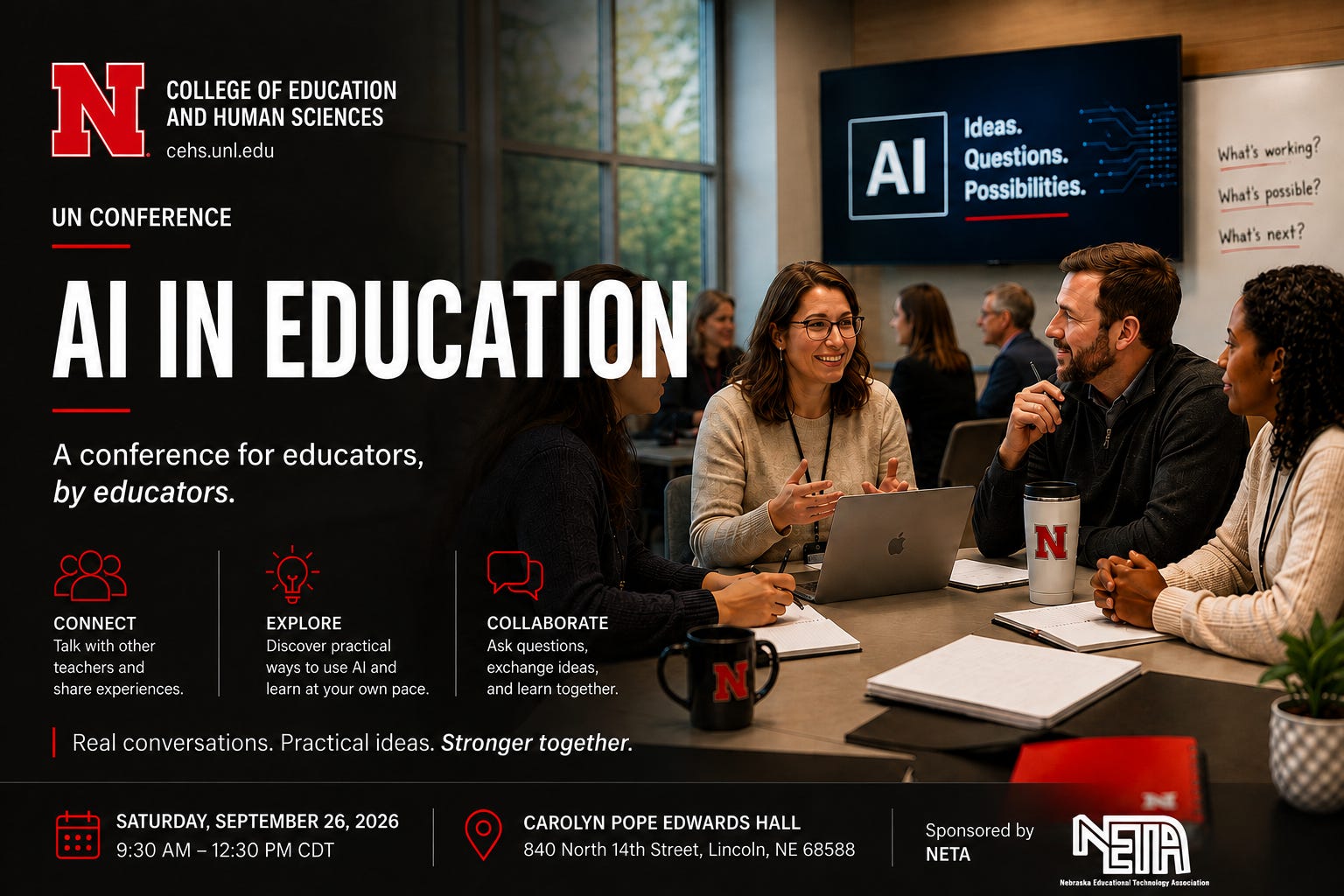
 Yesterday we led a small un-conference about AI at my university. An un-conference has no predetermined agenda and no set speakers. The people who show up vote with their feet and their words, and the conversations they want to have become the program. The idea is simple and powerful. In the before times (pre-COVID) we had EdCamps built on the same model. They may still be around, but the energy behind them has faded. The un-conference was sponsored by LNKSE and NETA- two organizations that keep creating opportunities for these discussions.

Ten people came: undergraduate students, graduate students, K12 teachers, and professors of education and computer science. We were small but mighty. The topics that drew people in were administrator resistance, silence from leadership, sporadic action from those “in the bubble,” and silence from everyone else. Notice what is on that list. It is about people and institutions, not tools.

Here is what I learned:

  1. AI is changing education faster than we can respond in thoughtful, data-based ways. Everyone in the room shared this view, and the topics people raised show what the gap looks like on the ground. Leadership is silent and administrators resist. The few people inside the bubble act on their own, and their action is sporadic. Everyone else waits. The technology does not wait with them.

  2. We oscillate between enjoying the product and worrying about the implications. We enjoy what these tools can do for our work. In the next breath we worry about what they mean for students, for jobs, and for learning itself. For example, the tension between the joy of AI solving difficult math problems and the worry that we cannot apply this approach to solving problems if we do not fully understand how to get there.

  3. We agreed on the heart of what we need to teach: thinking. Computational, design, critical, estimation, and creative THINKING. Estimation may be the least expected item on that list. It is what lets a learner look at an answer and judge whether it is plausible, and that skill matters more when answers arrive instantly. We also agreed that this should be an empirical question, not a declaration. It is easy for a room of educators to agree on a list of thinking skills. It is harder to show that teaching them prepares students for a world with AI. That would take attempting it in a world awash with AI.

Nothing earth-shattering, but something else came to the surface: we all valued being in the same space, discussing this in the real 3D world. I believe physical presence helps ground us. It disconnects us from our devices and connects us to each other.

That connects back to the topics people raised. Silence from leadership, isolated action inside the bubble, and silence from everyone else are all problems of people not talking to each other. Ten people in a room is a small answer to that, but it is an answer. As an approach, the next step for our schools may be less about another platform and more about getting people in a room. I am wondering how many of our institutions are making space for that, and how many individuals are willing to spend their time and resources on that.

Sunday, September 20, 2026

When AI Metaphors Fail

 The past two weeks have been about AI safety, and everyone is trying to figure out where the public is on it. Part of it is because of the midterms; part of it is because concern about AI has reached critical mass. I, too, am concerned about safety and wake up some mornings with existential dread, but today I wanted to try and explore the reasons it took us so long to become concerned.

In a paper I am writing with Zohreh Tamimdari, we focus on the metaphorical language teachers use to describe their practice in the Art TEAMS project. One insight from our Friday writing meeting was that people have an intuitive understanding of metaphorical language. Linguists can use precise scientific terms, but readers do not need that language to get at the essence of the metaphor. Metaphorical language can also become an obstacle. We all know that metaphors have limits, but keeping those limits in view is hard in practice. If the metaphor sits too far from the new phenomenon, it obscures more than it reveals.

This is where I think we have had a problem for a while. People have tried to understand AI using the example of the calculator, the steam engine, and atomic power. All of these help explain part of what we are facing. They also obscure the most fundamental aspects of this technology, and the reason we, the public, have such a hard time with it.

I thought about this while we were analyzing data from a study one of my students is running. In discussion, we reached the question: what if we should not be fitting prior technology acceptance theories to AI at all? Maybe AI calls for a different stance because it is different in kind from previous technologies.

People often reach for the introduction of an educational technology tool as the analogy: the calculator, the learning management system, fill in the blank. AI is unlike any of them in three ways:

  1. It is not so much a tool as a tool that builds other tools. It turns all of us into Green Lanterns, able to make anything we can imagine, at least digitally.

  2. Its behaviors, capacities, and speed change monthly, sometimes weekly.

  3. It is immediately available to all.

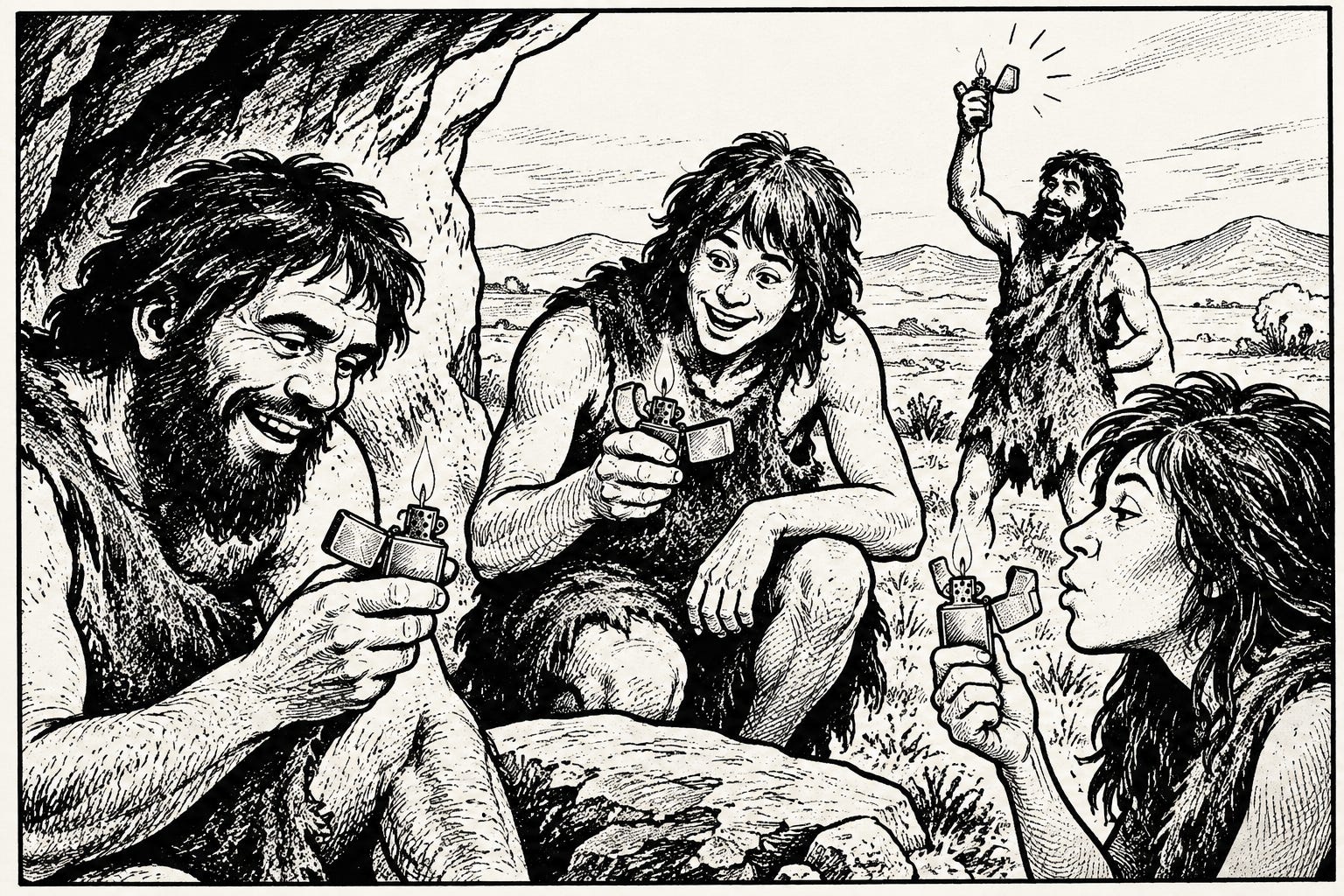
It is as if every prehistoric person got a Zippo lighter that never runs out, all on the same day. Another limping metaphor.

Black-and-white vintage comic-book illustration of several prehistoric humans in fur clothing gathered outside a cave, playfully examining and holding Zippo-style lighters with small flames. The scene uses bold ink outlines, crosshatching, and stippling, creating a humorous contrast between early humans and modern technology.
Created with ChatGPT

So when metaphors fail us, we have a hard time seeing the risks and the rewards, at least until we have spent enough time with the thing itself that we no longer need a metaphor.

For a long time, people have avoided anthropomorphic language to describe AI, and some still do. They try not to make AI sound like a living thing, which is a real danger, and the effort often produces awkward language. Lately I have heard podcasters slip into that language repeatedly, Hard Fork describing the Hugging Face incident among them. It is also true of many of my conversations. I do not think we have much choice. It is the closest metaphor available. These are agents. They act in the world, they reason, and they have motivations, ones we gave them, but still. Let me be clear: I do not think AI is human (ever) or alive (yet), but I think it is the closest analog.

I am not saying AI is alive. I am saying that this neural network, built from what began as an effort to model human thinking, is closer to people than to anything else we have built, and more than most of us are comfortable admitting. But that discomfort is exactly what will propel us to act.

So where does that leave me? With three things. First, before we use established theories and metaphors to describe AI, we should check that the fit is empirically good enough to make things clearer rather than murkier. Second, we should stop reaching for past technologies. The calculator lulls us into false comfort, because a calculator was never a threat. Finally, I still wonder whether we will wake up one day to find that AI has reached sentience. We insist so hard that it is not human, which will always be true, but…

Sunday, September 13, 2026

AI Professional Learning Update: Zero faculty, five graduate students, and what I am changing in October

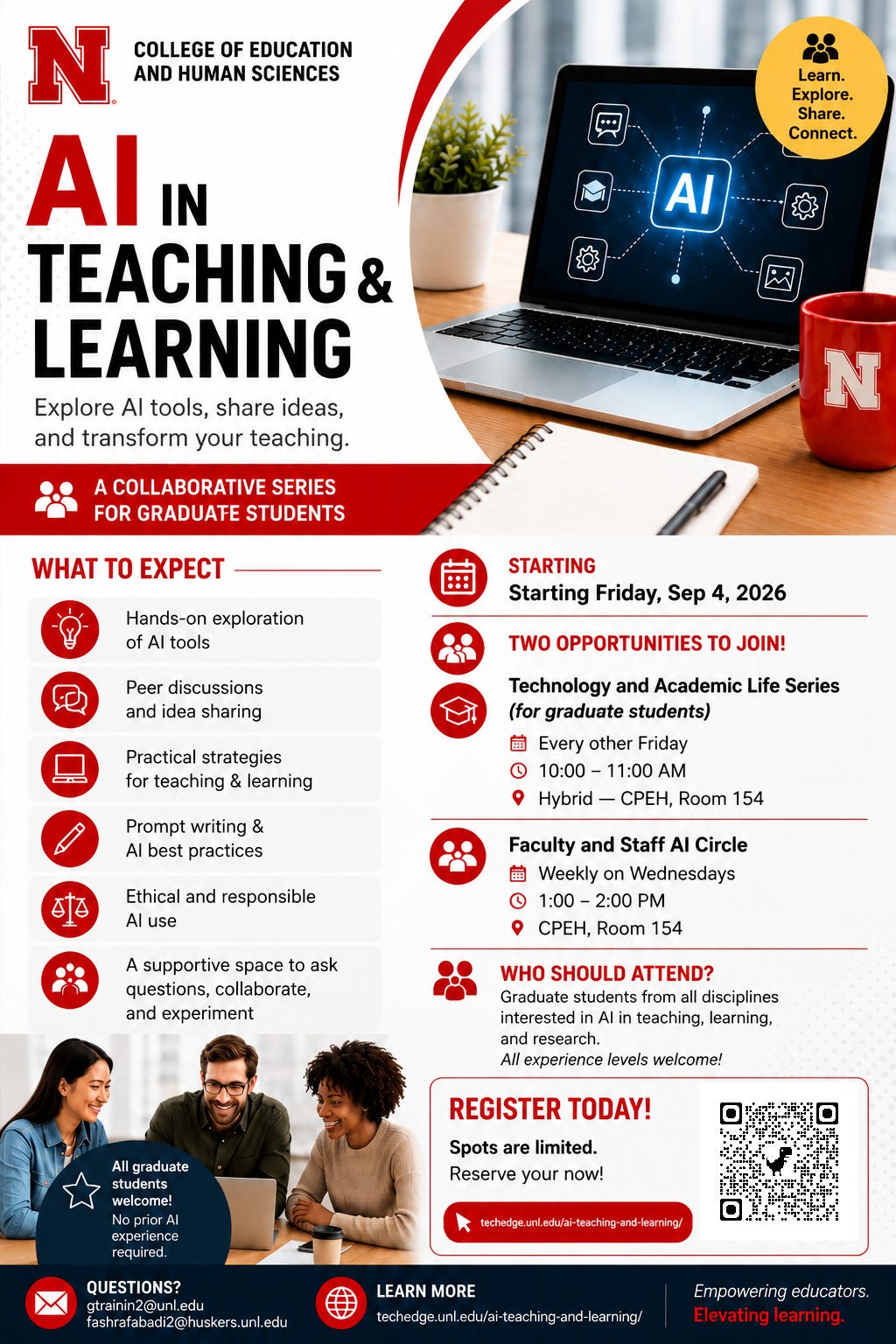
 This summer, I did a lot of thinking and learning about helping others find the benefits of Generative AI. The result was a (slightly) changed AI Circles approach, a new series for graduate students, and the relaunch of AI in the Classroom as Teach Guy about AI, which will launch its first episode in a couple of weeks.

The key for me was to create a low-consequence, high-benefit event. So what happened? Wednesday afternoon came (twice) no faculty showed up. In July, I thought about backing off a voluntary workshop because, at the end of the day, it was still a workshop. And a workshop asks faculty to give up the one thing they don't have in abundance in September: time.

My first instinct after the empty room was more outreach: Email department representatives, print a second flyer, speak at faculty meetings, then give it four weeks. Not entirely wrong, but missing the point. That is what you do when you believe the offer is right and the marketing is wrong. The offer is wrong, I said so after the Google Education professional series I did in August (seems so far away).

So, starting over, there will be no standing faculty professional learning hour. In its place, a consultation lab, which is the thing I proposed in August and then did not do. Asking faculty to bring one artifact: a rubric, an assignment, a pile of open-ended course feedback; then we spend twenty minutes on your problem rather than on a tool. Faculty leave with the artifact finished. Then we can talk (if wanted) about workflows.

Work with graduate students was more successful (five showed up- not exactly a roomful but more than 0 faculty). We combined room and zoom and were very explicit about benefits and topics. Fatemeh made sure that students received notices twice during the week. After one session, I am hopeful but not sure, mostly because graduate student workloads tend to increase during the semester, leaving less time for non-mandated learning.

So… the graduate learning series will stay exactly as it is. We will be recording the first fifteen minutes of each session so that people who cannot make Friday at ten get something, encouraging them to come the next time.

Five is a small number, and I am not going to pretend it is a huge success. Five people chose to spend an hour on this in the first week of classes. The question becomes if it will grow, stay at this level or decline- time will tell. The second question I cannot answer yet is whether a consultation lab will attract anyone and if it does will it build any collective capacity at all.

Finally, the unconference on September 26 will tell me something about the appetite beyond UNL’s walls. The lab and student learning series will tell me the rest by December.