I have always wanted project management software that could truly help me. Nick and I even recorded a couple of episodes of Not That Kind of Doctor about that search. I never found the holy grail. I always ended up back in my notes app or a notebook, and every few months I had to reboot the whole system. When vibe coding came around, I tried to build my own research tracker. I had a vision of different stages, and AI did produce a few products, but they worked like the older ones. They took quite a bit of work up front and were hard to keep up.
My new solution emerged from AI, but also from my own difficulty. AI pushed me to study it in a variety of ways, and ideas and collaborations multiplied quickly. What had been a minor problem became a major one.
Then I came across the idea of creating an AI Chief of Staff agent. Instead of vibe coding a structure, I simply asked Claude to create a project tracker. I built categories around the funnel from idea to publication. Then I set up a cycle with a Monday morning update on priorities for the week and a Friday prompt for updating what got done.
All of that information lives in a simple .md file written in plain language. Each project stays in a category until it moves forward to the next one, for example from research idea to IRB writing, or from analysis and writing to submitted. I usually work through the AI interface, but occasionally I open the file itself. It is completely readable because it is plain text.
Because the process gave me exactly the support I had been missing for years, I added things that were not strictly research projects in the funnel, at least not originally. The tracker now includes conference proposals, grant proposals, and even plans for the podcasts.
Each project also has a running notes file with next actions and progress updates, so the tracker can actually update itself and flag delays or, in the case of the podcasts, weeks without guests. Without much fanfare, working with this agent has made me considerably more productive while reducing my cognitive load.
What this week looked like
Here is a snapshot from this week. One book came out. Thirteen manuscripts are under review with no decisions. That sounds like progress until you look at the rest of the list.
A paper I meant to submit on October 5 now has a new target of October 30.
A pilot study has moved its start date three times. It will now run in my class in November because we did not have enough participants.
One writing project had shown no movement through eleven review cycles. We set a reboot date of November 12.
Another project is pushed to December 1.
A journal just asked for another round of revision on a paper I thought was nearly done.
One data collection site launched. The other is still waiting on a consent form.
Two new projects also showed up. One is a pilot tied to a grant proposal that was not funded this round. The other is in such an early design phase that my tracker had no category for it, so we created one.
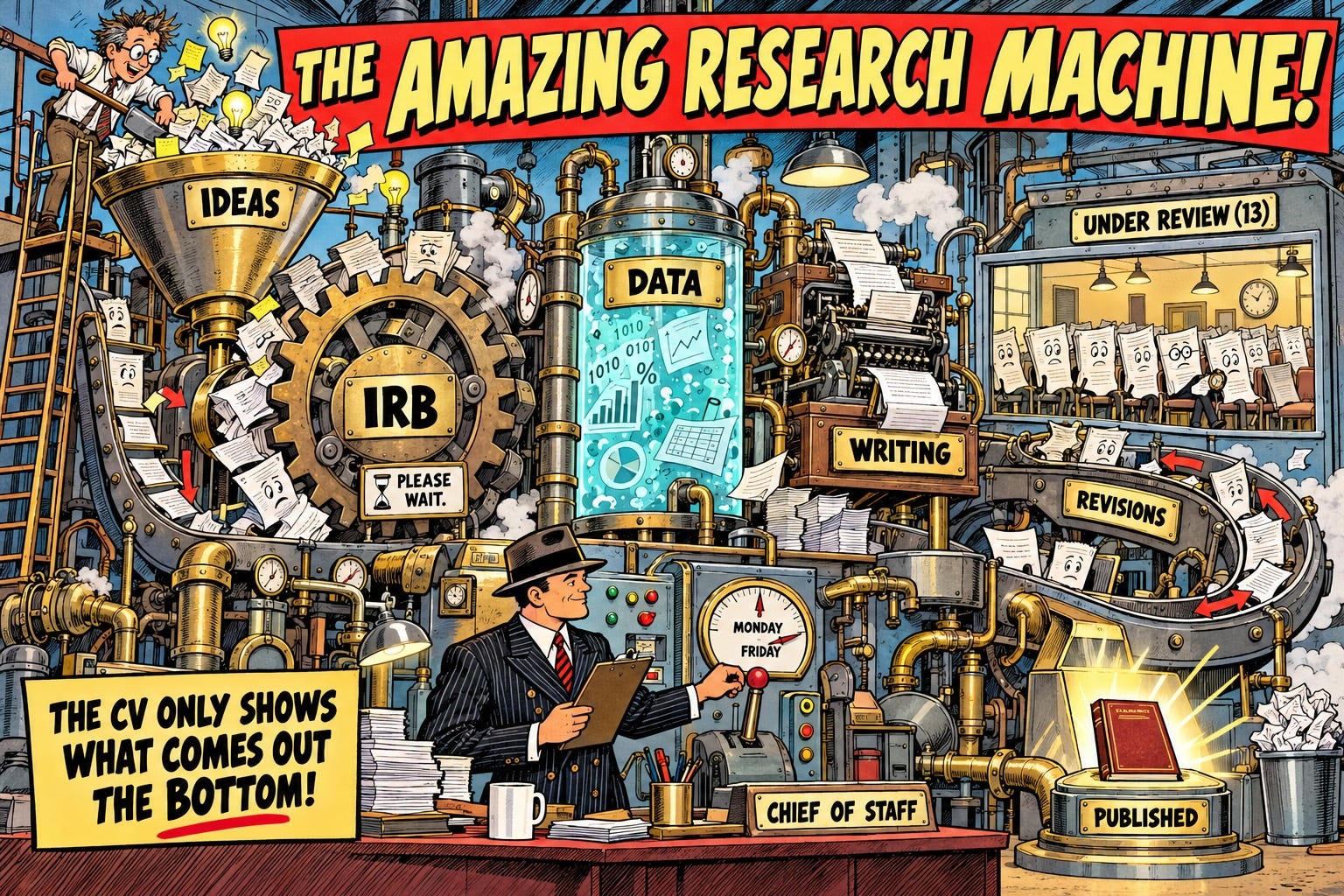
None of this is unusual. This is what a wide research program looks like from the inside, and it rarely matches the CV, which is always a lagging indicator.
What my Chief of Staff can and cannot do
My agent sets reminders, helps me set priorities, and gets me ready for the next step. My thoughts are more organized and my actions more purposeful. What it cannot do is reduce the friction with the real world. It cannot recruit participants, hurry the IRB, or speed up my grant reviews.
Since I started my project tracker, I stopped using my notes app and notebooks, and I no longer feel the urge to find another productivity app. There is no special maintenance or buildup. I just sit down when I have a few minute and say- let upadte my tracker lets go one category at a time, that's it. Sometimes I do it with a voice interface and sometimes typing but the update is in plain language and with my running notes connected most of it is automatic with me just making sure it is accurate.
What I gain is visibility into both successes and delays. I can see the whole picture while still focusing on one assignment at a time during the work week. The other benefit, for someone like me, is seeing the full scope of the work. I understand what comes next, and I say yes to fewer things. My long list of articles under review gives me pause. Each one will likely come back for revisions at least twice and then become a priority, so I need to make sure I have the bandwidth to handle them. Call it self-regulation with AI.


No comments:
Post a Comment