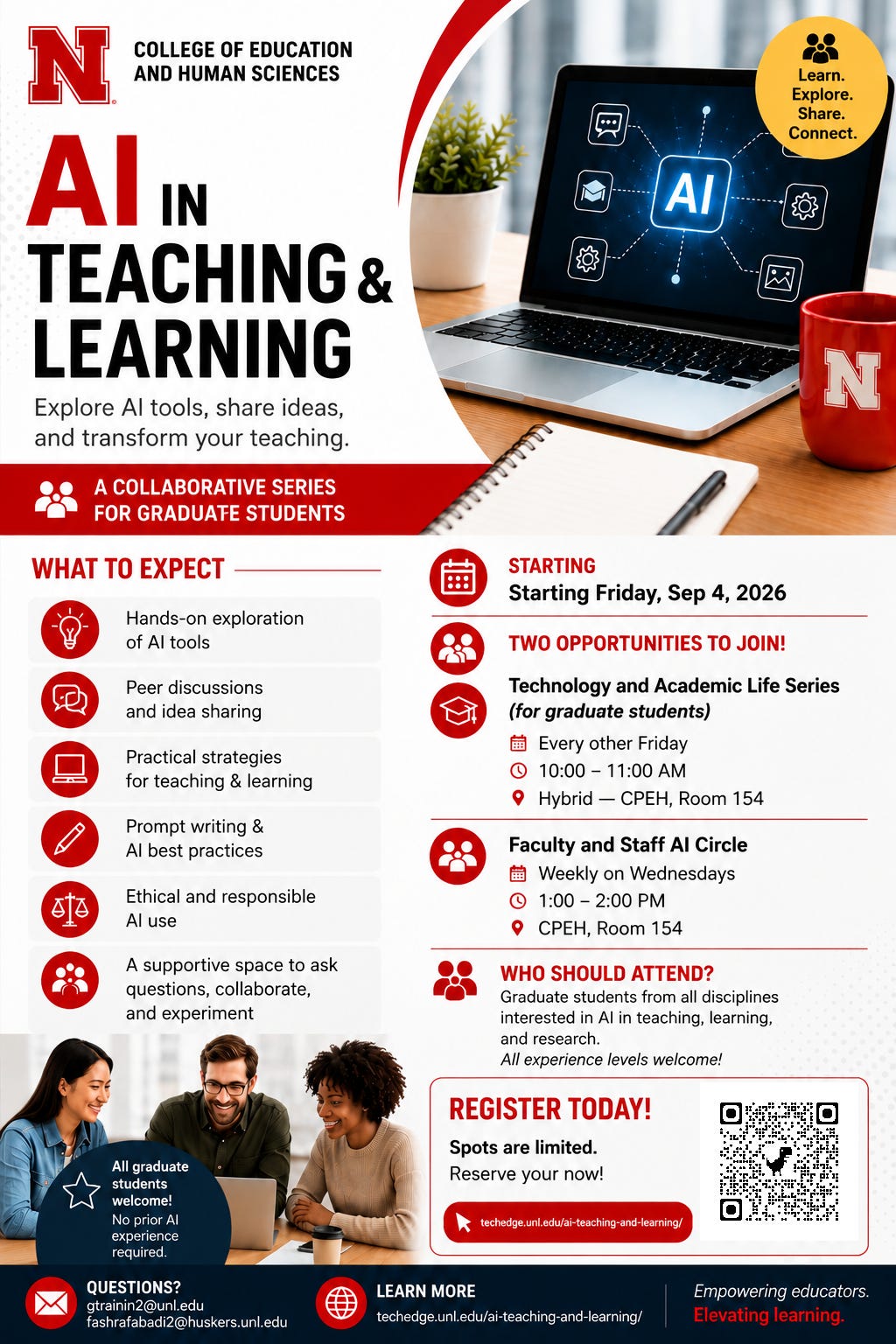
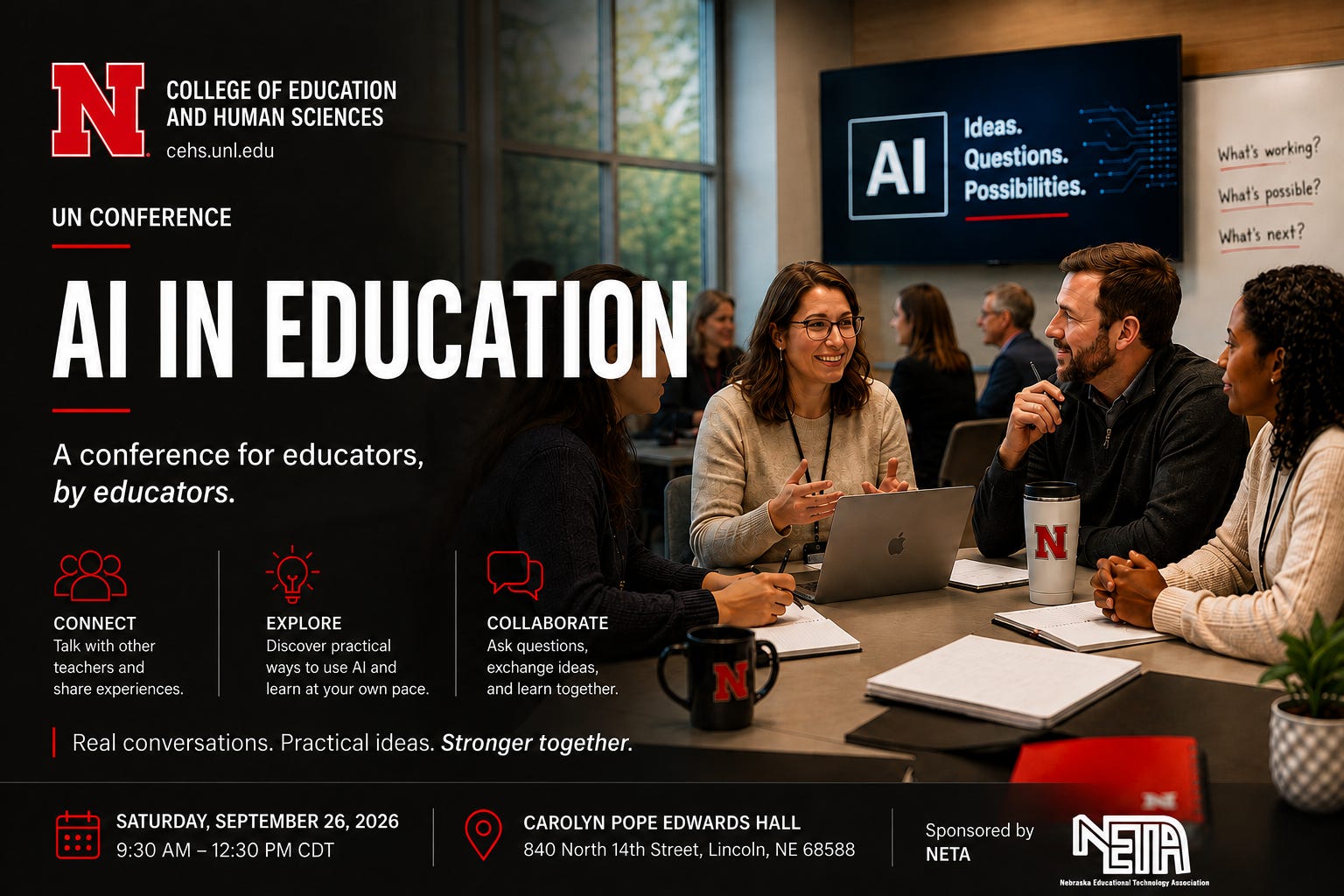
This summer, I did a lot of thinking and learning about helping others find the benefits of Generative AI. The result was a (slightly) changed AI Circles approach, a new series for graduate students, and the relaunch of AI in the Classroom asTeach Guy about AI, which will launch its first episode in a couple of weeks.
The key for me was to create a low-consequence, high-benefit event. So what happened? Wednesday afternoon came (twice) no faculty showed up. In July, I thought about backing off a voluntary workshop because, at the end of the day, it was still a workshop. And a workshop asks faculty to give up the one thing they don't have in abundance in September: time.
My first instinct after the empty room was more outreach: Email department representatives, print a second flyer, speak at faculty meetings, then give it four weeks. Not entirely wrong, but missing the point. That is what you do when you believe the offer is right and the marketing is wrong. The offer is wrong, I said so after the Google Education professional series I did in August (seems so far away).
So, starting over, there will be no standing faculty professional learning hour. In its place, a consultation lab, which is the thing I proposed in August and then did not do. Asking faculty to bring one artifact: a rubric, an assignment, a pile of open-ended course feedback; then we spend twenty minutes on your problem rather than on a tool. Faculty leave with the artifact finished. Then we can talk (if wanted) about workflows.
Work with graduate students was more successful (five showed up- not exactly a roomful but more than 0 faculty). We combined room and zoom and were very explicit about benefits and topics. Fatemeh made sure that students received notices twice during the week. After one session, I am hopeful but not sure, mostly because graduate student workloads tend to increase during the semester, leaving less time for non-mandated learning.
So… the graduate learning series will stay exactly as it is. We will be recording the first fifteen minutes of each session so that people who cannot make Friday at ten get something, encouraging them to come the next time.
Five is a small number, and I am not going to pretend it is a huge success. Five people chose to spend an hour on this in the first week of classes. The question becomes if it will grow, stay at this level or decline- time will tell. The second question I cannot answer yet is whether a consultation lab will attract anyone and if it does will it build any collective capacity at all.
Finally, the unconference on September 26 will tell me something about the appetite beyond UNL’s walls. The lab and student learning series will tell me the rest by December.
I am heading out, as I do most Sundays, to meet with the biking group. No, I don't bike; more than that, I don't want to be judged for joining a biking group coffee conversation without having biked there. I love solving the world’s problems before noon and then returning to my everyday life having had a meaningful, even joyful interaction, without biking.
Why am I sharing this? I have been thinking about the backlash against (and shaming of) AI-generated everything, but most prominently, writing. I want to be judged by the quality of my ideas, the clarity, and the flow of what I want to say. Just like I want to show up for the biking group not having biked, without judgment. When I read AI, it is the same; I do not want to care if it was generated (or smoothed) by AI; I want to care about the content and the ideas.
The truth is that it takes discipline. There is ample work that shows that AI users are better at spotting AI writing. I am not sure I am better than average, but there are cases when I am quite sure that I am reading AI. Notice I did not say AI slop, just AI. And that is the distinction for me: slop is slop whether AI-generated or not.` Coherent arguments are coherent regardless of authorship.
What I noticed, especially when I do peer reviews, is that I have an instinctive reaction to writing that strikes me as Claude-ish (or AI-ish). My bias translates to: “if you asked AI to write this, why did you ask me to read this? Why should I care?” This has also been documented as the AI tax: people devalue what they perceive (accurately or not) as a product of AI. As with other cognitive biases, I have to use metacognitive strategies to shape the bias and ask the more substantive question. What is the merit of the argument? What does it add to our scientific knowledge? Where can it be better. The biggest challenge may be that cognitive biases are notoriously hard to shake. Kahenmann said: “This is the essence of intuitive heuristics: when faced with a difficult question, we often answer an easier one instead, usually without noticing the substitution.” ― Daniel Kahneman, Thinking, Fast and Slow
Few of us are immune to this blind spot. In the case of AI I am painfully aware that dismissing AI is a lazy heuristic but that does not make it much easier to overcome. I make a special effort to work through the text and get to the heart of the argument.
Notice I am not claiming that AI text is better. In fact, I believe it is often worse because it tends to use expected but dense language. The point is that I need to judge it on its own merit without considering the source.
This argument does not hold in education. In my classes, I am teaching students to think, and so evaluating the argument made by AI is irrelevant; the point was to teach humans to think. This makes AI a much more nuanced partner. In science, the only question is whether science has moved forward; in training teachers, the question was whether they developed the discernment and capacity.
The education part requires more thought (or so Claude has informed me) but I am off to meet the bike group.
Our graduate students are training for professional and academic careers, but our curriculum was built for a world before AI.
This isn’t an indictment; curricula move slowly by design. They encode what a field has agreed on, and agreement takes time. AI adoption is uneven, along what Ethan Mollick calls the jagged edge: strong in some tasks, unreliable in others, and on an improvement trajectory that makes next year (nearly) unforeseeable. A program that rewrote itself around last year’s capabilities would be revising again this year. Caution is a reasonable response.
The cases for using AI in academic work are tricky. Authorship is contested; Data protection rules were written before anyone pasted an interview transcript into a chat window. Faculty attitudes range from enthusiasm to anxiety, fear, and even hatred, and behind these emotions there are real arguments. I don’t think anyone is wrong to be uneasy.
I do think we are getting the cost of waiting for clarity wrong.
Our graduates are entering fields where AI literacy is already assumed. They will submit (and referee) to journals with AI disclosure policies. They will sit on IRB panels. They will be asked by a district or a dean or a search committee what their position is, and “I wasn’t taught that” is not a position. Sending them out without practical skill and a defensible ethical stance is not neutrality. It is a decision, and the cost lands on them.
On our podcast recently, a graduate student walked through how he arrived at his own working relationship with these tools. Not refusal, not delegation. He described testing where the tool helped his thinking and where it replaced thinking he needed to do himself, then settling into a level he could defend. It is about finding the Goldilocks level.
That process is what I want to teach. He got there on his own, which is fine for some but useless as a program design. Some students will figure it out. Others will land on one extreme or the other and stay there, and neither extreme serves them. Guiding students through that calibration is what post-secondary education is for. We do it with statistics, with critical theory, with writing. There is no reason to treat AI differently.
So rather than complaining in my writing (an exercise I enjoy), I am adding something alongside it. Starting this term, I am offering a free weekly work session for graduate students. Not a lecture series. Work time, with structure. Students bring their own projects, and each session anchors on a cluster of questions with substantial time to try things and see what breaks.
My initial plan covers nine clusters:
Authorship and agency. COPE standards, journal policies, what disclosure actually requires, and where the field has not settled.
Privacy and data protection. What you can put in a model, what you cannot, and how IRB commitments constrain your workflow.
AI in the literature review process. Where it accelerates search and synthesis, and where it steers you wrong.
Building a researcher identity with your AI. Setting up context so the tool works from your frameworks and your voice rather than a generic average.
Qualitative analysis. Promises and pitfalls, coding assistance, and the risk of losing contact with your data.
Quantitative analysis. Code generation, assumption checking, and verification you still have to do yourself.
Designing research instruments. Item generation, revision, and validity questions that do not go away but may look different.
AI as a teaching assistant. For their teaching, and for their own learning.
Friction and learning. Information processing theory, and why removing effort from a task sometimes removes the learning with it.
That last cluster matters most to me, and I plan to keep returning to it. Ease is not the goal. Some cognitive work has to happen in the student’s head, or it does not happen at all, and knowing which work that is separates skilled use from outsourcing.
I expect the list to change once students tell me what they actually need. That is part of the point. The clusters are a starting structure.
The argument is simple. Our students will practice in a field that has already changed. We can hand them the skill and judgment to work in it, or we can leave them to assemble it alone, after they graduate, with the stakes considerably higher. Those are the two options. There is no version where the question goes away.
P.S. Sarah often says that she hates this timeline. I often agree but until we can join the Time Variance Authority- this is pretty much it.
I started this week sitting across from a long-time colleague, someone whose work I respect and whose judgment I trust. Let’s call him Eric. Eric is co-authoring something with a younger scholar, and he has been finding hallucinated references in the manuscript. He has, I think, tacitly accepted that AI was used in the writing. The references are the tell. He has not said so explicitly, but the evidence is sitting right there in the reference list.
What struck me about the conversation was not the hallucinations. Those are a real problem, and anyone using AI-assisted writing needs to know that. What struck me was that Eric is not using AI himself, which means his mental model of the technology is frozen at whatever he last heard about it. He does not know yet that frontier models (the current generation) are substantially less prone to fabricating citations than earlier versions. His experience of the technology is secondhand and dated, and that gap between perception and current reality is itself a kind of problem. The tool is a moving target, and the critique needs to move with it.
Later in the week, I had a completely different kind of conversation. Dave Fowler, a math education professor who retired a few years ago, shared with me the exchanges he has been having with ChatGPT about the nature of theories. Dave is curious, playful even about what this thing is and what it can do.
He shared some of the thinking he was doing with and about AI. We smirked together at the turns of phrase the model deployed in those conversations, including things like “You’re drawing a very precise and interesting analogy, Dave.” which my brain heard in the voice of HAL 9000. There is something both charming and slightly unnerving about that sentence. It flatters, it redirects, it sounds like a thoughtful interlocutor. Is it? Is it not? Dave was not sure, and neither was I, and that wondering felt like the right place to be.
I am still turning that conversation over in my head. What Dave is modeling is something I think we are not talking about enough in education: what it looks like to approach AI with curiosity rather than with a verdict already in hand. He retired, he has no institutional pressure either way, and for $20 a month he is just... exploring. There is something intellectually honest about that.
Uncertainty Saloon (Created with ChatGPT)
Meanwhile, the news cycle this week offered its own jagged edges.
And then Barnes & Noble CEO James Daunt appeared on the Today show and said he had no problem stocking AI-written books, as long as they were clearly labeled and not misrepresenting themselves. Cue the boycott calls. Cue the “all generative AI is ripping off someone else” counter-arguments on social media. Daunt has since clarified, repeatedly, that Barnes & Noble does not knowingly sell AI-generated books and takes active measures to exclude them. The clarification landed with about as much impact as you would expect, which is to say, not much. The outrage had already found its shape.
These two stories (the prize and the bookstore) are related. Both are really about thresholds. At what point does AI-assisted become AI-generated? Who gets to decide? What is the meaningful distinction between a human writer who uses AI as a tool and one who uses it as a ghostwriter? I do not have clean answers. What I am sure of is that any calls for no AI will just feed into shadow AI use.
On a more personal note: I have been noticing that when I write text on my own, without AI assistance, Grammarly flags it as AI-generated. (I still have a Grammarly subscription, though the controversy around the company has me reconsidering that). The flag itself made me stop and think. Am I absorbing AI patterns from all this use? Or is this a simpler and more uncomfortable explanation: that AI was trained on enormous quantities of mediocre writing (including mine), and is now reflecting the patterns of mediocre writing back at us, and Grammarly is simply recognizing them? I am a mediocre writer, so am I no better than AI?
I find this genuinely interesting and only slightly humbling.
Social media, that well-known venue for nuanced and measured discourse, has been full this week of a particular kind of certainty. The message, in various forms, is this: In five years you will look back and realize that AI in schools was a terrible mistake.
I do not know how to evaluate that claim, because I do not think anyone can know it. We are, as a society on the verge of something, but the outcomes are unclear. The people making this prediction with the most confidence tend to be the ones least encumbered by curiosity or evidence. As Ted Lasso misquoted “Be curious, not judgmental.” I think of Dave Fowler, sitting with his ChatGPT transcripts, genuinely wondering, and then I think of the social media certainty crowd, the UnDaves. The UnDave has an opinion. The UnDave does not let curiosity or facts complicate the opinion. The UnDave is very confident about what five years from now will look like.
I am not an UnDave. I hope I never become one. Here is where I am, for this week at least.
I love the exploration. I love what AI does for the scope and scale of what I can get done. And more than either of those things, I love that GenAI keeps opening doors to new questions, questions I would not have thought to ask, problems I would not have noticed, conversations like the one with Dave that I will be thinking about for weeks.
On schools specifically: I have said this before, and I will say it again. Caution is warranted. We do not have enough evidence yet about long-term impacts on learning, on writing development, and on productive struggle that builds capacity. Those concerns are legitimate and deserve to be taken seriously.
But on the other side of that, we must teach students about AI, what it is, how it works, and how it is changing the world they are growing up in. Not doing so is irresponsible. These students are going to live in a world shaped by this technology, whether we prepare them for it or not. Much like sex ed, if we don’t teach about it in schools, they will learn it elsewhere, with potential negative consequences.
I understand the desire to put the djinni back in the bottle. But we learned from the nuclear age that you cannot undo technologies. We must work as a society to reckon with the age of AI, and part of that is education.
Eric’s colleague used AI and did not know how to use it well. Dave used AI and understood enough to find the conversation genuinely interesting. The difference is not access. The difference is curiosity and intellectual engagement.
That is what education is (or at least should be).