The past two weeks have been about AI safety, and everyone is trying to figure out where the public is on it. Part of it is because of the midterms; part of it is because concern about AI has reached critical mass. I, too, am concerned about safety and wake up some mornings with existential dread, but today I wanted to try and explore the reasons it took us so long to become concerned.
In a paper I am writing with Zohreh Tamimdari, we focus on the metaphorical language teachers use to describe their practice in the Art TEAMS project. One insight from our Friday writing meeting was that people have an intuitive understanding of metaphorical language. Linguists can use precise scientific terms, but readers do not need that language to get at the essence of the metaphor. Metaphorical language can also become an obstacle. We all know that metaphors have limits, but keeping those limits in view is hard in practice. If the metaphor sits too far from the new phenomenon, it obscures more than it reveals.
This is where I think we have had a problem for a while. People have tried to understand AI using the example of the calculator, the steam engine, and atomic power. All of these help explain part of what we are facing. They also obscure the most fundamental aspects of this technology, and the reason we, the public, have such a hard time with it.
I thought about this while we were analyzing data from a study one of my students is running. In discussion, we reached the question: what if we should not be fitting prior technology acceptance theories to AI at all? Maybe AI calls for a different stance because it is different in kind from previous technologies.
People often reach for the introduction of an educational technology tool as the analogy: the calculator, the learning management system, fill in the blank. AI is unlike any of them in three ways:
It is not so much a tool as a tool that builds other tools. It turns all of us into Green Lanterns, able to make anything we can imagine, at least digitally.
Its behaviors, capacities, and speed change monthly, sometimes weekly.
It is immediately available to all.
It is as if every prehistoric person got a Zippo lighter that never runs out, all on the same day. Another limping metaphor.
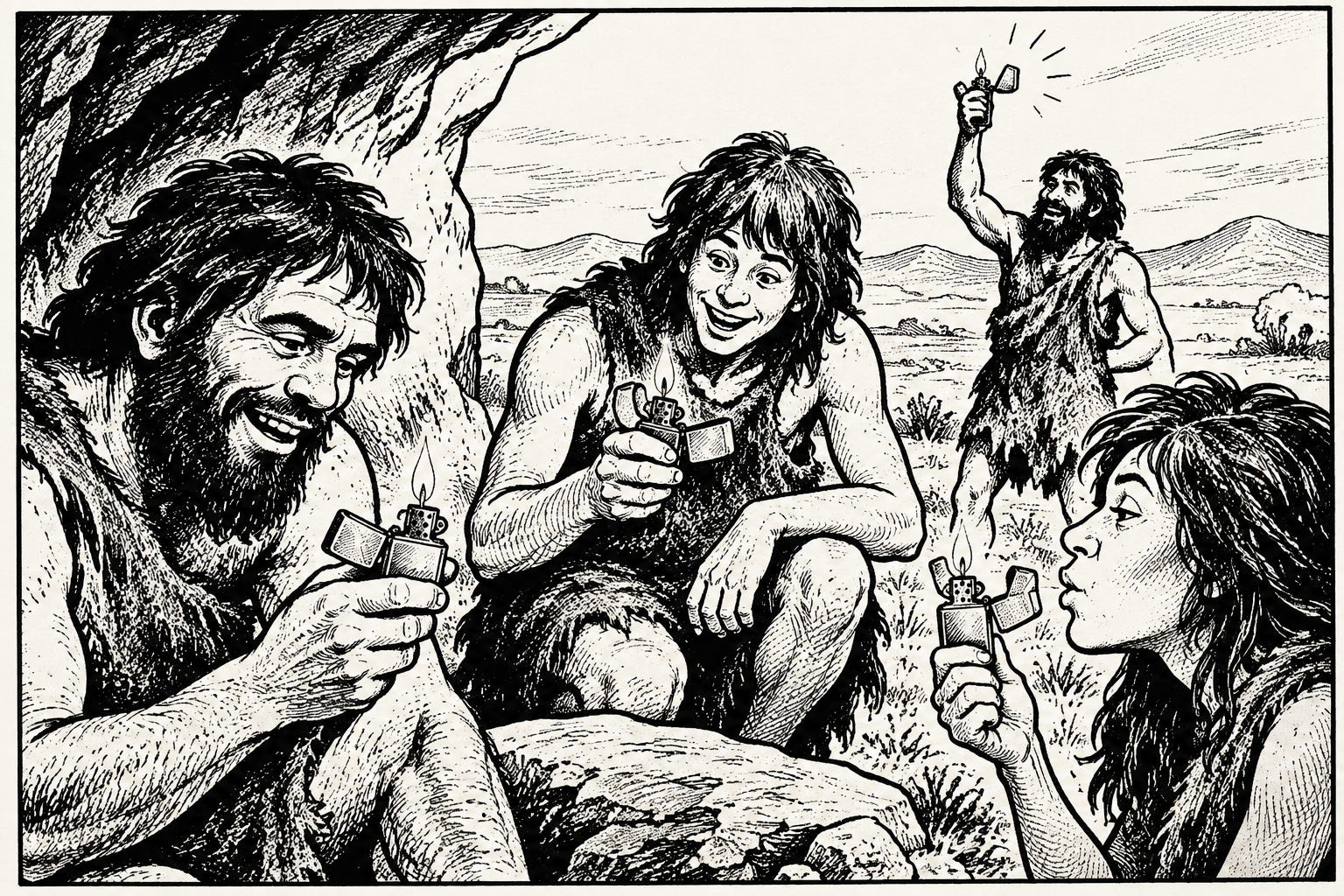
So when metaphors fail us, we have a hard time seeing the risks and the rewards, at least until we have spent enough time with the thing itself that we no longer need a metaphor.
For a long time, people have avoided anthropomorphic language to describe AI, and some still do. They try not to make AI sound like a living thing, which is a real danger, and the effort often produces awkward language. Lately I have heard podcasters slip into that language repeatedly, Hard Fork describing the Hugging Face incident among them. It is also true of many of my conversations. I do not think we have much choice. It is the closest metaphor available. These are agents. They act in the world, they reason, and they have motivations, ones we gave them, but still. Let me be clear: I do not think AI is human (ever) or alive (yet), but I think it is the closest analog.
I am not saying AI is alive. I am saying that this neural network, built from what began as an effort to model human thinking, is closer to people than to anything else we have built, and more than most of us are comfortable admitting. But that discomfort is exactly what will propel us to act.
So where does that leave me? With three things. First, before we use established theories and metaphors to describe AI, we should check that the fit is empirically good enough to make things clearer rather than murkier. Second, we should stop reaching for past technologies. The calculator lulls us into false comfort, because a calculator was never a threat. Finally, I still wonder whether we will wake up one day to find that AI has reached sentience. We insist so hard that it is not human, which will always be true, but…


No comments:
Post a Comment