Showing posts with label teacher education. Show all posts

Sunday, October 18, 2026

The Order Matters More Than the Tool

 Over the past few weeks, I kept seeing the same move in places that have nothing to do with each other.

For the past year, our Design Futures workshop has started the same way. Participants take a piece of paper and sketch a bicycle built for a Nebraska winter. Then they snap a photo of the sketch and ask AI to reproduce it, sometimes from the drawing and sometimes from a written description. By the time AI enters the process, a lot of thinking has already happened. Sometimes the results are fantastic. Sometimes the AI hands back a bike that floats above the pavement, not by intent, but because that is what it perceived.

Last week we interviewed Nick Husbye on the podcast, and he described something curiously similar. Nick asks his preservice teachers to draft a lesson plan by hand. When they have a draft, they let the AI come in and critique the plan. What Nick teaches is that AI can be a very good critic, and that the teacher still has the agency to say, “I hear this critique, but it doesn’t apply here, and here’s why.”

The third example comes from our work with Southeast Community College, where we are asking Writing Center tutors how they work with AI. One tutor described a simple structure they give students.

  1. Start with the rules. Know what your instructor allows so you don’t break them.

  2. Use your own words.

  3. Only then bring in AI to critique, improve, and suggest.

Finally, in Tina Shetabi’s work on using AI in the fashion design process som students reported that starting with AI gave them a strong sense that it is not their work. When they started with their own sketch, they felt more ownership.

Overhead photograph of a wooden desk featuring a pencil sketch of a fat-tire snow bicycle beside a tablet displaying a realistic 3D rendering of the same chainless bicycle floating approximately 10 inches above a snowy mountain trail. A pencil, ruler, coffee cup, and plant surround the designs in soft natural light.
Created with ChatGPT

The pattern

These are four examples from the last few weeks, and there are more. None of these people coordinated. Each one puts human thinking first and AI second, sometimes third. Each treats AI as a critic or collaborator that extends the existing work or points out what isn’t working. The ideas stay thoroughly human. As Nick puts it, AI should amplify your thinking, not export it.

Why the order matters

All four cases involve novices, people entering a domain they are becoming experts in but are at the beginning stages. That might mean designing a bike, writing a lesson plan, drafting a paper in a writing class, or, designing a garment. For novices, the priority is learning the domain and thinking it through.

A while ago I called this the novice problem. Novices are less likely to develop if they start with AI. We want them to start with their own thinking, let AI mirror back what is working and what isn’t, and then iterate. Some of that iteration can happen with AI, but in many cases I want them to go back and iterate with their own thinking.

The novice’s first draft does two things. It gives them something to compare the AI against, and it gives them a sense of ownership.

When students start with AI, they tell us they don’t feel ownership. Their sense of agency is taken away. They often go with whatever the AI made, and they become less and less critical. We want students critical enough to compare what they intended with what is on the page, and to learn from that comparison instead of being replaced by it.

The bikes show how this works. Students asked AI to add cup holders, which is a fine idea. Some kept pushing until the bike had 30 cup holders in ridiculous places. They knew immediately it was funny and implausible. Because AI will go as ridiculous as you ask, stretching it shows students quickly where it doesn’t understand the physics of a working bike or a wearable garment.

That signal leads to metacognition. Even as novices, they are the ones who can evaluate the result, because the work started with their intent.

What this isn’t

This is not an argument against AI. In each case, the AI step adds real value. It also isn’t a universal rule.

The sequence lines up with decisions universities are making about when to bring AI into the curriculum in a more organized way, including the debate in computer science education about when and how much to introduce it. In most of our interviews with professors and students, both groups say the same thing. In entry-level classes, AI makes little sense as the creator. It becomes a crutch because it is too good, and students build up cognitive debt. Once learners move past that stage, the roles can shift. They need to learn how to use AI when they’re stuck, when they lack ideas, or when they need to do research. There are times when AI should go first.

What schools can do

Most AI policies, in K-12 and higher ed, focus on which tools are allowed and what counts as acceptable use. That’s fine. Many policies also leave a lot of agency to instructors, which is great, but instructors still need a framework to work from.

The better question is about sequence. What do students do, and in what order? The answer depends on how novice they are and how much expertise they bring. This changes the policy conversation. A tool can be allowed at one point in the process and not another, with a different intent at each stage.

A human sketches the bike, drafts the paper, or designs the garment. Then AI comes into play, because we can iterate much faster with it. We can ask for small changes or big ones, extend the thinking, or get a critique. Everything is judged against the original intent. That keeps the learner in control, even as a novice, and keeps the product connected to the person who created it.

Three practices make this work.

Model it yourself. Nick models his own failures with AI, and I try to do the same. I show what I used and where it didn’t work. That gives students permission to critique AI without rejecting all of it. It isn’t all in or all out. Sometimes I dump what the AI produces. Sometimes I’m amazed. Usually I’m somewhere in the middle. And sometimes I say out loud, “This isn’t very good. I prefer what I made myself, and I’m not sure AI was worth using here.”

Make comparison the assignment. Ask students to compare their intent with the final product and explain what they learned from the critique. That metacognitive move is where much of the learning happens.

Grade the comparison. If your students respond to grades, put significant weight here. AI output quality varies, so grading only the product partly grades the AI. Grading the comparison grades the thinking.

Where have you seen it work?

Nick’s advice to his students is simple. Write first. Use AI, but use it a little later.

These are observations from all of us grappling with how to teach in the age of AI. So my question is if you seen this sequence work, and where have you seen it fail?

Sunday, August 23, 2026

The Cost of Silence about AI

I apologize; I skipped a week of posting. It was my 60th birthday, and I was feeling existential angst. I had a topic ready, but when Sunday morning rolled around, I just could not bring myself to write. So apologies, but also maybe you had a few more minutes for yourselves, which is never a bad idea.

The topic I wanted to write about last week is the peculiar situation that is uniquely American. Older Americans see AI more positively than younger generations n(though not be much). My inquiry into this issue began when I had a chance encounter with a colleague who retired quite a few years ago; after recognizing me, he excitedly said he would love to meet and talk about AI. A few months ago, I shared about another former colleague who wanted to share and learn about what we were doing and thinking. At the same time, many of my colleagues and quite a few of my undergraduate students react with resistance, which I accept, but also an emotional response that is hard to process. So, older pAmericans were welcoming and younger ones rejecting AI. I wanted to know if my anecdotal data collection was backed up with more data. It turns out this is a trend that the Pew and others have noted in large scale polling.

This is hard to disentangle because this is not universal. International data shows a more familiar trend, with younger people more excited and positive about AI. I believe that the reasons are complex and multi-layered, including our disillusionment with the Tech industry, especially social media, and our rising environmental concerns. This may be uniquely American because the companies driving this change are US (and Chinese) companies, and we feel we should have a stake and a say, whereas the rest of the world lacks that sense of agency. This is not my point though.

In multiple conversations with colleagues exploring this world of AI and its impact, I heard frustration and a sense of foreboding. We are becoming reluctant to talk about our work because we do not wish to be the subjects of an emotional response or get drawn into an argument. The cost of talking about AI is rising, and it is impacting our ability to talk about what the field is experiencing.

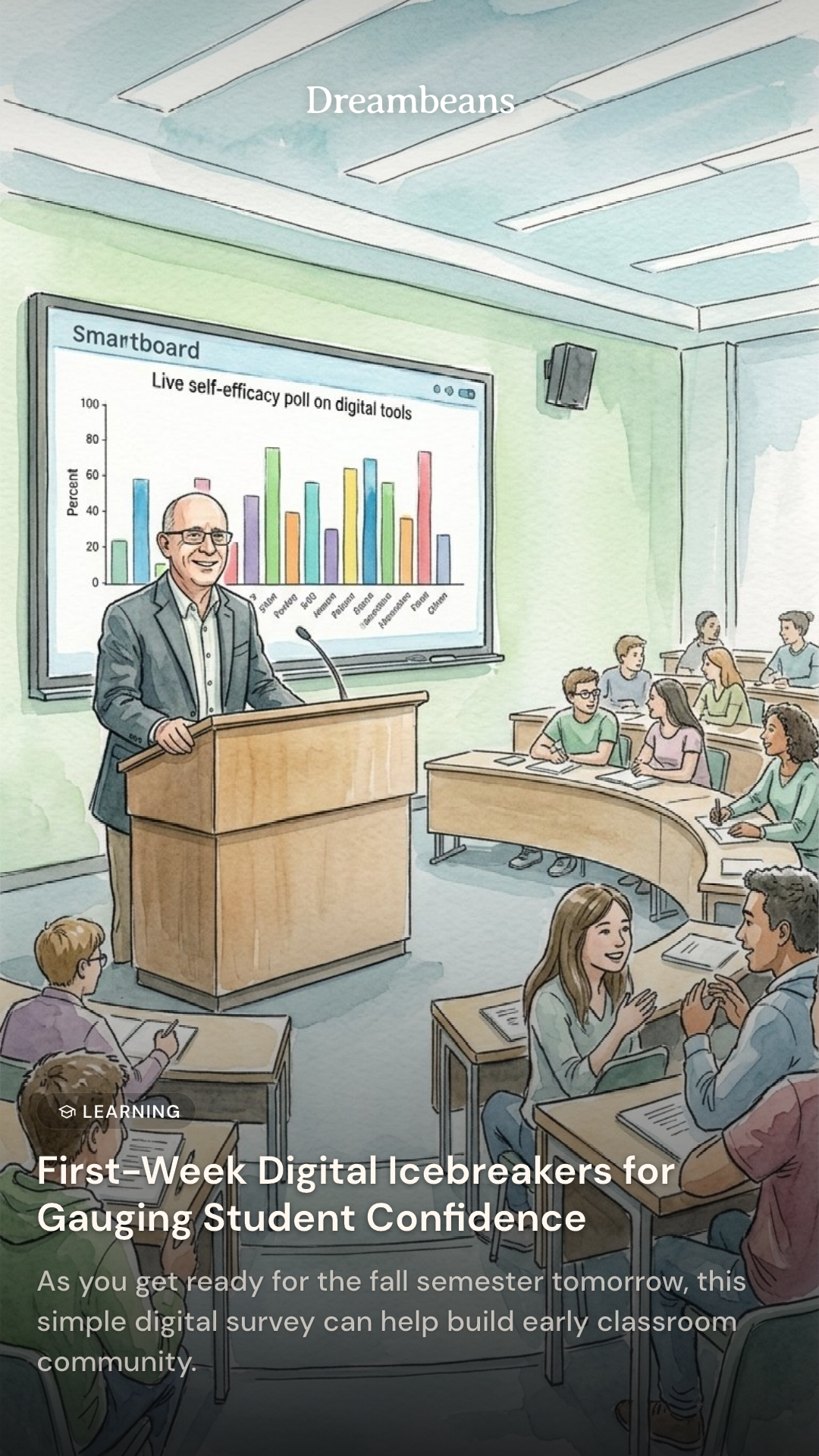
Here's alt text for the image:  Concise version (for most uses): A watercolor-style illustration of a smiling instructor standing at a wooden podium in a lecture hall, presenting a bar chart titled "Live self-efficacy poll on digital tools" on a large smartboard. Diverse students sit at curved tiered desks, some applauding. Header reads "Dreambeans"; caption is labeled "Learning — First-Week Digital Icebreakers for Gauging Student Confidence."
From Gemini Dreambeans App

This brings me to the beginning of the semester. I am teaching a class about technology integration. AI must have a seminal presence in that class. I found myself dreading broaching the subject with my students. This dread is useful because it makes me more deliberate and thoughtful about the scaffolds and exit ramps I put in place. I must open the world of AI to my students; it will be their world, and if they choose to reject AI, I want them to do so from a place of understanding and acknowledgment of the tradeoffs. The cost of that silence may be too high as we prepare professionals who will not be able to face the moment, who will not be able to prepare their students for a world where AI in everywhere and expected.

SO I will get over myself and introduce AI its advantages and concerns throughout the curriculum. Wish me luck!

Thursday, April 25, 2024

Exploring Generative AI in Teacher Preparation Call for proposals

 Title/Theme: Exploring Generative AI in Teacher Preparation

The Challenge 

Generative AI is rapidly becoming commonplace and coupled with the availability of personal devices and one-to-one technology adoption, we need to ensure that the current and future generations of teachers understand its implications, know how to adjust their pedagogy and how to use it to assist in lesson planning, assessment, and individualizing instruction. In this call, we are specifically inviting submissions from practitioners using evidence-based strategies in both pre-service and in-service teacher education. 

Submissions might focus on (but are not limited to): 

  • Personalized Learning 
  • Intelligent Tutoring Systems 
  • Automated Grading 
  • Data Analysis and Insights 
  • AI-driven Simulation and Virtual Reality in Teacher Education 
  • Feedback on teacher performance 
  • Lesson and assessment planning 
  • Inclusion and accessibility 
  • Chatbots in Learning and self-regulation 
  • Bots for socio-emotional learning 
  • Adaptive learning 
  • AI literacy for teacher educators 
  • What do teachers need to know in a world of Generative AI 
  • Teacher preparation in an age of Generative AI
  • Whose data? Who is learning? The complex realities of learning in an age of Generative AI 
  • Ethical and Equity Implications of Generative AI in Teacher Education 
  • The Economics of Generative AI and Teacher Education 
  • Cultural Sensitivity and the Deployment of AI in Diverse Educational Settings 
  • Assessing the Impact of Generative AI on Accessibility and Inclusion in Teacher Education 
  • Generative AI, Social Justice, and Educator Preparation. 

The Approach: 

In addition to an open call for proposals, we also intend to invite scholars to submit articles from those who have participated in events held by the AACTE Committee on Innovation and Technology (I & T Committee). Since the spring of 2023, the I & T Committee has held a series of webinars and online Lunch and Learn sessions focused on generative AI in teacher education. Researchers and practitioners familiar with AI tools shared policies, procedures, and practices with the AACTE community, leading to rich forward-thinking conversations about this timely topic. We will continue to hold these events leading up to a featured session at the AACTE 2025 Annual Meeting in Long Beach, CA, where some of these scholars and I & T Committee members will be presenters. 

  • Editors:
    Valerie Hill-Jackson, Ph.D., Texas A&M University
    Cheryl Craig, Ph.D., Texas A&M University
  • Guest Co-Editors:
    Guy Trainin, Ph.D., University of Nebraska- Lincoln
    Laurie Bobley, Ed.D., Touro University
    Punya Mishra, Ph.D., Arizona State University
    Jon Margerum-Leys, Ph.D., Oakland University
    Peña L. Bedesem, Ph.D., Kent State University

Manuscript Guidelines 

Authors are encouraged to submit manuscripts that meet the following criteria: 

  • All manuscripts must be fully blinded to ensure a reliable review process. 
  • All manuscripts must meet publishing guidelines established by the American Psychological Association (APA) Publication Manual (7th edition, 2019). 
  • A manuscript, inclusive of references, tables, and figures, should not exceed 10,000 words. 
  • No more than one manuscript submission per author. 
  • Read more JTE guidelines. 
  • To submit your manuscript, please visit the JTE website. 

Timeline for Submission 

  • June 15, 2024: A 150-word bio for each author, a 300-word structured abstract, and 5 keywords due to guest editors. Email these items to jmleys@oakland.edu and the subject line should read: ‘JTE Anniversary 76(3) – Abstract’. 
  • September 1, 2024: Manuscript submission deadline for ‘Level 1’ external review; see the above guidelines. Manuscripts need to be in ‘near publication’ quality to move forward to the Level 2 review. 
  • November 15, 2024: Level 1 – External peer review completed. 
  • December 10 through January 10, 2025: ‘Level 2’ review by guest editors; feedback is provided to prospective authors on a rolling basis. 
  • Noon (CST) Saturday, February 1, 2025. All final manuscripts must be received in the Sage online system for consideration of publication in JTE’s 75th anniversary issue on Generative AI, 76(3). The publication date is targeted for May 2025.