Showing posts with label edtech. Show all posts

Sunday, September 20, 2026

When AI Metaphors Fail

 The past two weeks have been about AI safety, and everyone is trying to figure out where the public is on it. Part of it is because of the midterms; part of it is because concern about AI has reached critical mass. I, too, am concerned about safety and wake up some mornings with existential dread, but today I wanted to try and explore the reasons it took us so long to become concerned.

In a paper I am writing with Zohreh Tamimdari, we focus on the metaphorical language teachers use to describe their practice in the Art TEAMS project. One insight from our Friday writing meeting was that people have an intuitive understanding of metaphorical language. Linguists can use precise scientific terms, but readers do not need that language to get at the essence of the metaphor. Metaphorical language can also become an obstacle. We all know that metaphors have limits, but keeping those limits in view is hard in practice. If the metaphor sits too far from the new phenomenon, it obscures more than it reveals.

This is where I think we have had a problem for a while. People have tried to understand AI using the example of the calculator, the steam engine, and atomic power. All of these help explain part of what we are facing. They also obscure the most fundamental aspects of this technology, and the reason we, the public, have such a hard time with it.

I thought about this while we were analyzing data from a study one of my students is running. In discussion, we reached the question: what if we should not be fitting prior technology acceptance theories to AI at all? Maybe AI calls for a different stance because it is different in kind from previous technologies.

People often reach for the introduction of an educational technology tool as the analogy: the calculator, the learning management system, fill in the blank. AI is unlike any of them in three ways:

  1. It is not so much a tool as a tool that builds other tools. It turns all of us into Green Lanterns, able to make anything we can imagine, at least digitally.

  2. Its behaviors, capacities, and speed change monthly, sometimes weekly.

  3. It is immediately available to all.

It is as if every prehistoric person got a Zippo lighter that never runs out, all on the same day. Another limping metaphor.
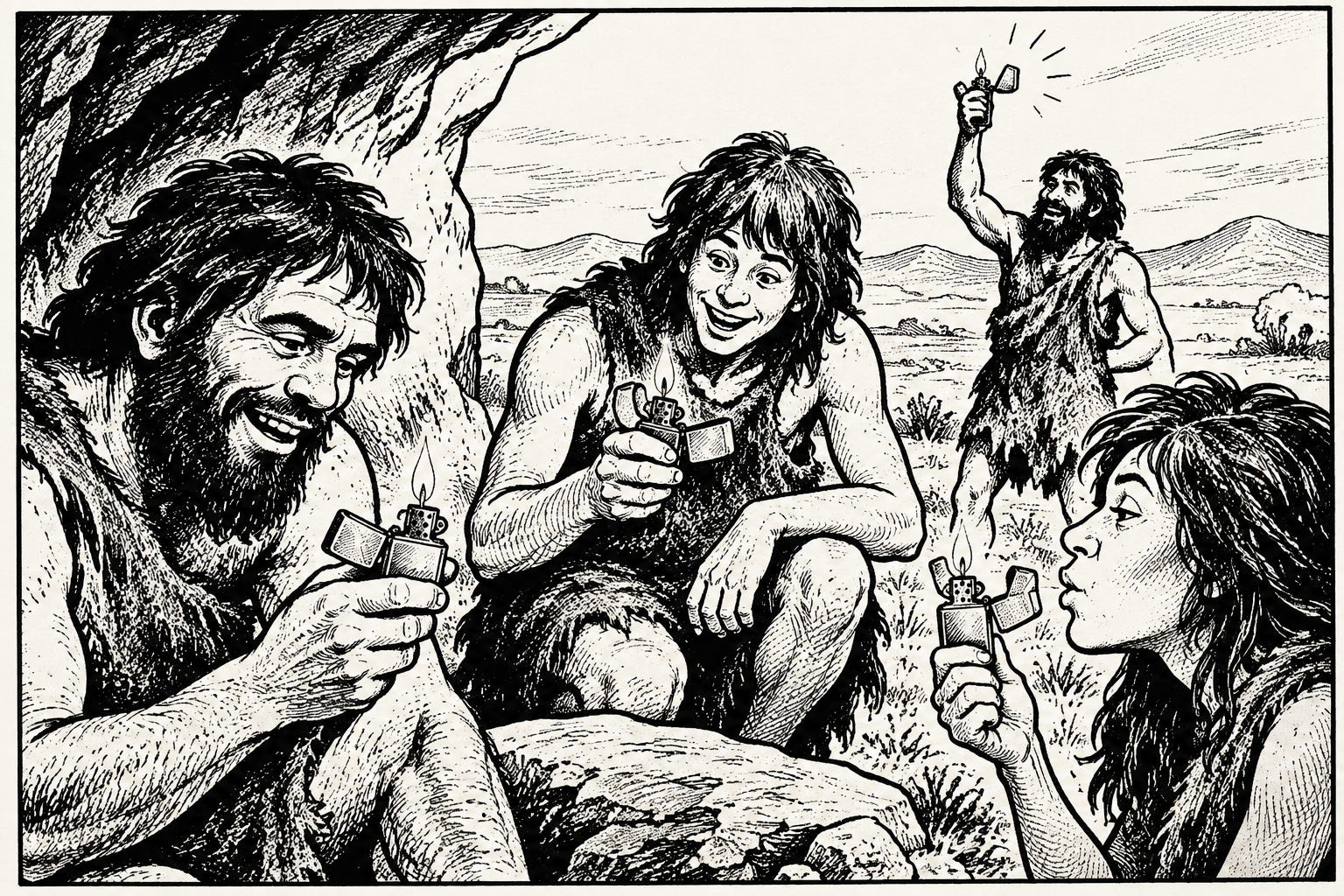
Black-and-white vintage comic-book illustration of several prehistoric humans in fur clothing gathered outside a cave, playfully examining and holding Zippo-style lighters with small flames. The scene uses bold ink outlines, crosshatching, and stippling, creating a humorous contrast between early humans and modern technology.
Created with ChatGPT

So when metaphors fail us, we have a hard time seeing the risks and the rewards, at least until we have spent enough time with the thing itself that we no longer need a metaphor.

For a long time, people have avoided anthropomorphic language to describe AI, and some still do. They try not to make AI sound like a living thing, which is a real danger, and the effort often produces awkward language. Lately I have heard podcasters slip into that language repeatedly, Hard Fork describing the Hugging Face incident among them. It is also true of many of my conversations. I do not think we have much choice. It is the closest metaphor available. These are agents. They act in the world, they reason, and they have motivations, ones we gave them, but still. Let me be clear: I do not think AI is human (ever) or alive (yet), but I think it is the closest analog.

I am not saying AI is alive. I am saying that this neural network, built from what began as an effort to model human thinking, is closer to people than to anything else we have built, and more than most of us are comfortable admitting. But that discomfort is exactly what will propel us to act.

So where does that leave me? With three things. First, before we use established theories and metaphors to describe AI, we should check that the fit is empirically good enough to make things clearer rather than murkier. Second, we should stop reaching for past technologies. The calculator lulls us into false comfort, because a calculator was never a threat. Finally, I still wonder whether we will wake up one day to find that AI has reached sentience. We insist so hard that it is not human, which will always be true, but…

Sunday, September 13, 2026

AI Professional Learning Update: Zero faculty, five graduate students, and what I am changing in October

 This summer, I did a lot of thinking and learning about helping others find the benefits of Generative AI. The result was a (slightly) changed AI Circles approach, a new series for graduate students, and the relaunch of AI in the Classroom as Teach Guy about AI, which will launch its first episode in a couple of weeks.

The key for me was to create a low-consequence, high-benefit event. So what happened? Wednesday afternoon came (twice) no faculty showed up. In July, I thought about backing off a voluntary workshop because, at the end of the day, it was still a workshop. And a workshop asks faculty to give up the one thing they don't have in abundance in September: time.

My first instinct after the empty room was more outreach: Email department representatives, print a second flyer, speak at faculty meetings, then give it four weeks. Not entirely wrong, but missing the point. That is what you do when you believe the offer is right and the marketing is wrong. The offer is wrong, I said so after the Google Education professional series I did in August (seems so far away).

So, starting over, there will be no standing faculty professional learning hour. In its place, a consultation lab, which is the thing I proposed in August and then did not do. Asking faculty to bring one artifact: a rubric, an assignment, a pile of open-ended course feedback; then we spend twenty minutes on your problem rather than on a tool. Faculty leave with the artifact finished. Then we can talk (if wanted) about workflows.

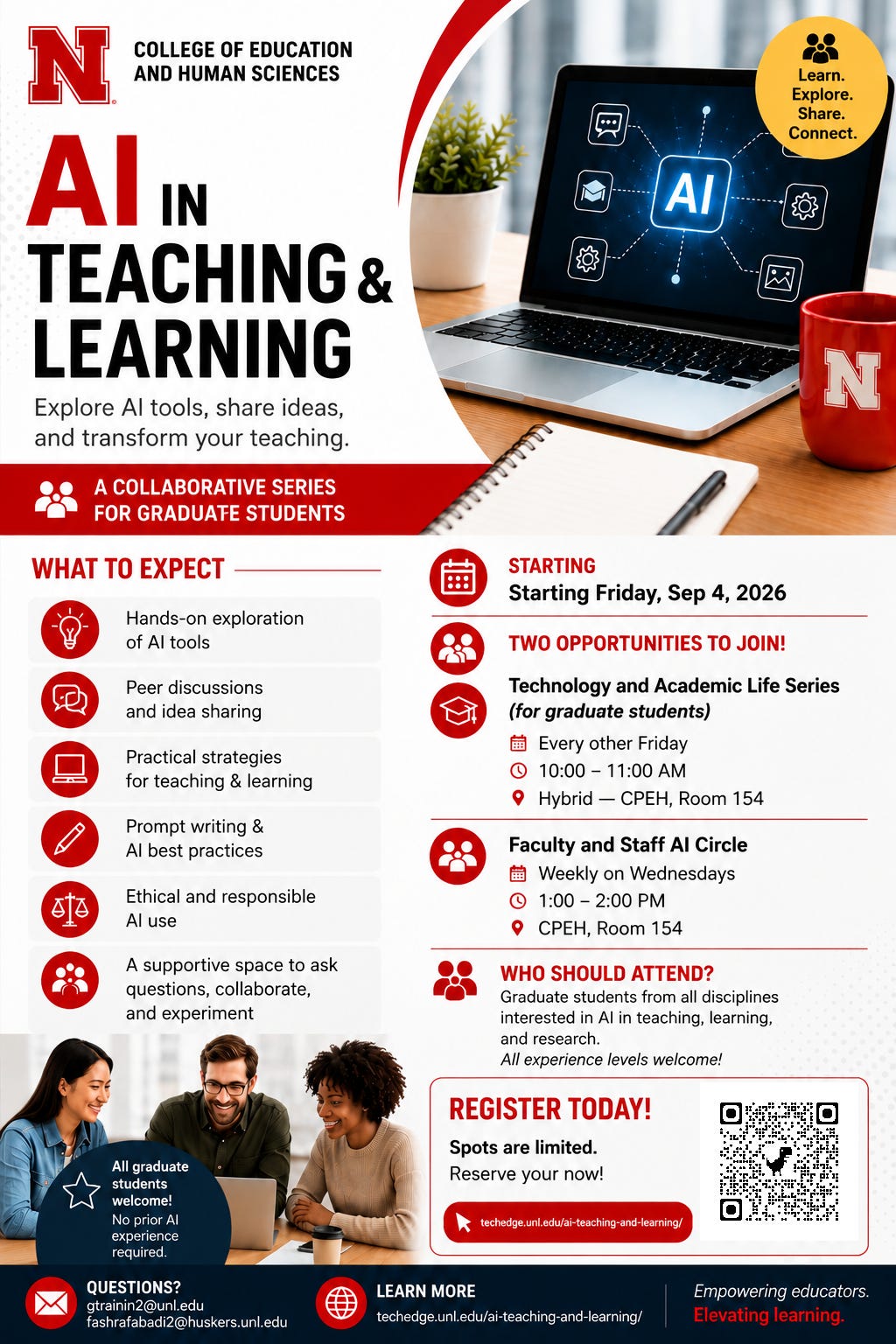
Work with graduate students was more successful (five showed up- not exactly a roomful but more than 0 faculty). We combined room and zoom and were very explicit about benefits and topics. Fatemeh made sure that students received notices twice during the week. After one session, I am hopeful but not sure, mostly because graduate student workloads tend to increase during the semester, leaving less time for non-mandated learning.

So… the graduate learning series will stay exactly as it is. We will be recording the first fifteen minutes of each session so that people who cannot make Friday at ten get something, encouraging them to come the next time.

Five is a small number, and I am not going to pretend it is a huge success. Five people chose to spend an hour on this in the first week of classes. The question becomes if it will grow, stay at this level or decline- time will tell. The second question I cannot answer yet is whether a consultation lab will attract anyone and if it does will it build any collective capacity at all.

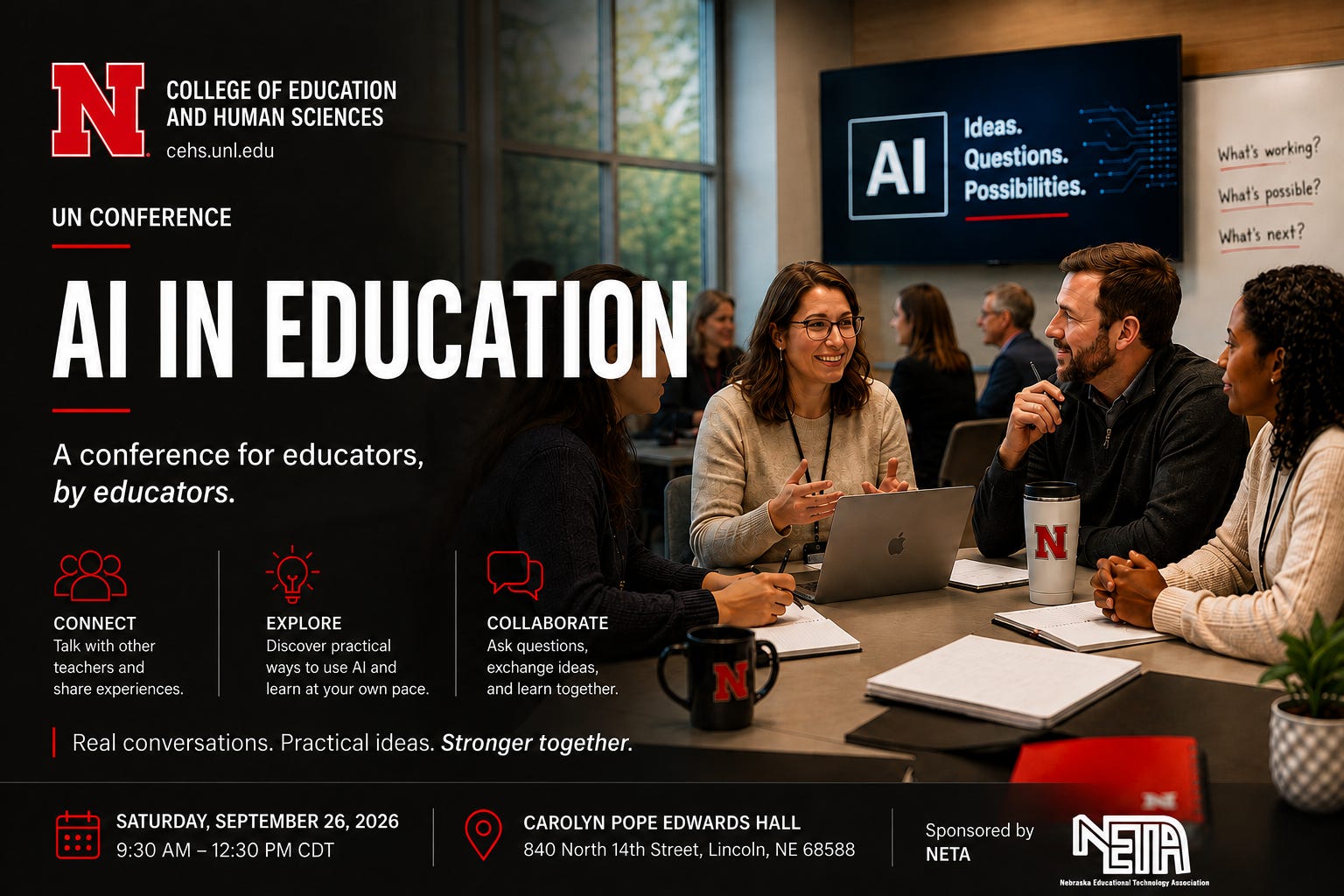
Finally, the unconference on September 26 will tell me something about the appetite beyond UNL’s walls. The lab and student learning series will tell me the rest by December.

Sunday, August 30, 2026

I don't bike to biking group: Grappling with Ai contradictions

 I am heading out, as I do most Sundays, to meet with the biking group. No, I don't bike; more than that, I don't want to be judged for joining a biking group coffee conversation without having biked there. I love solving the world’s problems before noon and then returning to my everyday life having had a meaningful, even joyful interaction, without biking.

Why am I sharing this? I have been thinking about the backlash against (and shaming of) AI-generated everything, but most prominently, writing. I want to be judged by the quality of my ideas, the clarity, and the flow of what I want to say. Just like I want to show up for the biking group not having biked, without judgment. When I read AI, it is the same; I do not want to care if it was generated (or smoothed) by AI; I want to care about the content and the ideas.

The truth is that it takes discipline. There is ample work that shows that AI users are better at spotting AI writing. I am not sure I am better than average, but there are cases when I am quite sure that I am reading AI. Notice I did not say AI slop, just AI. And that is the distinction for me: slop is slop whether AI-generated or not.` Coherent arguments are coherent regardless of authorship.

What I noticed, especially when I do peer reviews, is that I have an instinctive reaction to writing that strikes me as Claude-ish (or AI-ish). My bias translates to: “if you asked AI to write this, why did you ask me to read this? Why should I care?” This has also been documented as the AI tax: people devalue what they perceive (accurately or not) as a product of AI. As with other cognitive biases, I have to use metacognitive strategies to shape the bias and ask the more substantive question. What is the merit of the argument? What does it add to our scientific knowledge? Where can it be better. The biggest challenge may be that cognitive biases are notoriously hard to shake. Kahenmann said: “This is the essence of intuitive heuristics: when faced with a difficult question, we often answer an easier one instead, usually without noticing the substitution.”
― Daniel Kahneman, Thinking, Fast and Slow

Few of us are immune to this blind spot. In the case of AI I am painfully aware that dismissing AI is a lazy heuristic but that does not make it much easier to overcome. I make a special effort to work through the text and get to the heart of the argument.

Notice I am not claiming that AI text is better. In fact, I believe it is often worse because it tends to use expected but dense language. The point is that I need to judge it on its own merit without considering the source.

This argument does not hold in education. In my classes, I am teaching students to think, and so evaluating the argument made by AI is irrelevant; the point was to teach humans to think. This makes AI a much more nuanced partner. In science, the only question is whether science has moved forward; in training teachers, the question was whether they developed the discernment and capacity.

The education part requires more thought (or so Claude has informed me) but I am off to meet the bike group.

Monday, August 3, 2026

Elephants, Gorillas, No AI: Thoughts from a day spent at Nebraska Administrator Days

 The Nebraska Council of School Administrators puts on a summer event before school starts called Administrator Days. This year, for the third year in a row, I joined the conference, this time for just one day. I heard a lot about reading, changes to CTE, law, and behavior, but almost nothing about AI. Now, the Nebraska Department of Education and the ESUCC put together one session on the unified approach to Tech, including AI, and did an amazing job. But that was it. I tried to dig through the program and find a significant representation for this thing that is looming over us and disrupting our business as usual. Crickets.

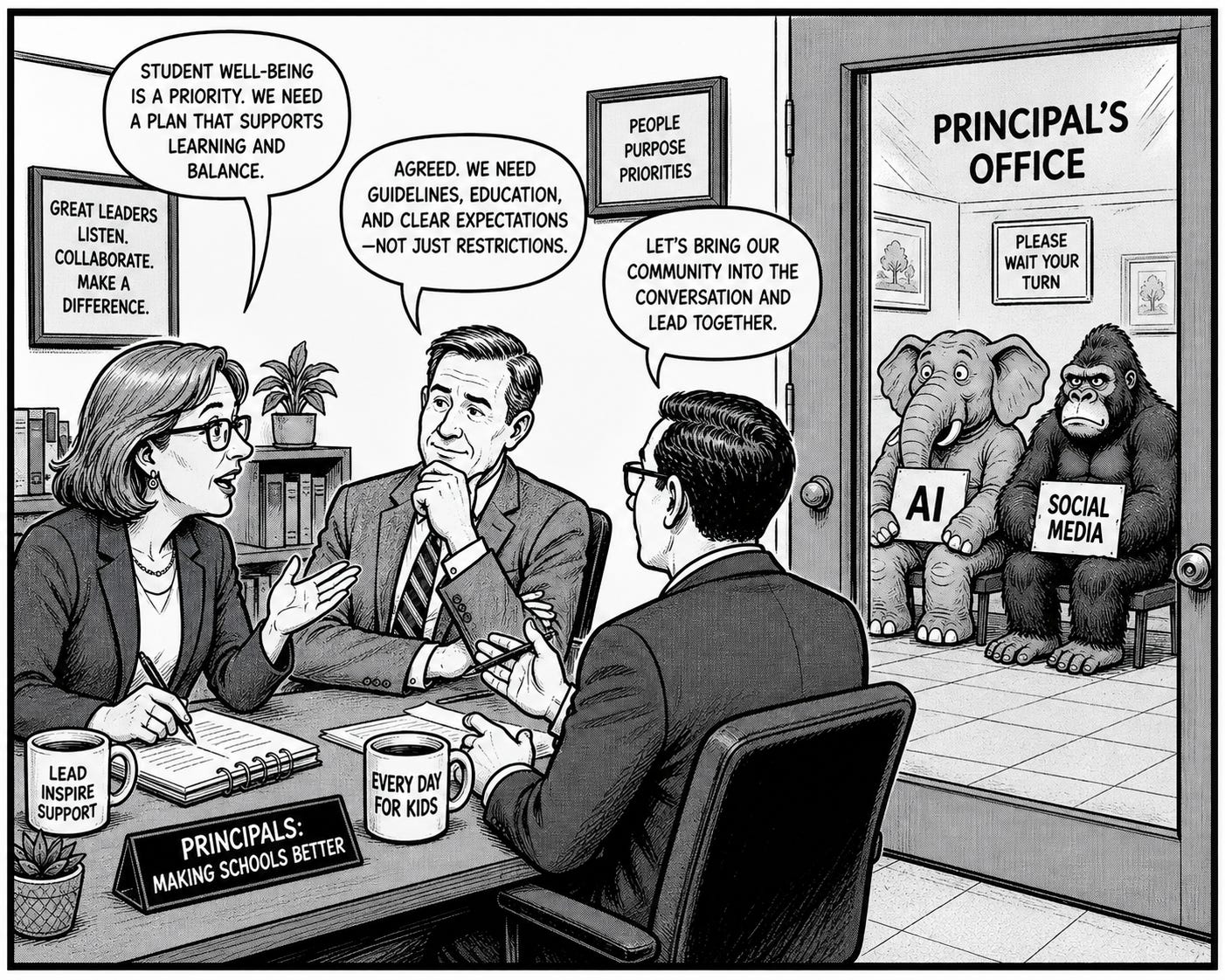
This is the elephant that isn’t in the room, the gorilla that was not invited, and whatever other metaphor you would like to have about ignoring a real problem.

Crickets.

I am of two minds here. Reading is still important, maybe more than ever. Focusing on basic skills and making sure our students are ready to tackle any and all academic work through this medium is important, mission-critical, crucial. Hell, I was trained as a professor of literacy and taught reading to students of all ages with a reading disability. Yes it is VERY important. So maybe, we should talk about it with our leaders. I actually love the focus from the deprtment, that says no matter

But the relative silence about AI. Not just in the room and the program but in the corridor conversations, hit me hard. AI is here; it is changing classrooms, learning, and what our students can and will do with or without permission. Most districts in Nebraska have adopted legal language around AI, warning against unethical use and making AI policy a topic for teacher decisions. In essence, school systems are making it teachers’ problem.

So the positive spin on the lack of conversation around AI is that our schools are not being distracted by this shiny new thing. They need to improve what they are doing for every student at any age. I am all in for focusing on what students need. Another reason can be that we need to wait for this innovation to settle before we do anything about it.

The not-so-positive look is that schools, through their leaders, are sending a message that this enormous change that is sweeping through society and is now available to any student who has access to the internet, is not a big deal. Is this the right message?

My fear is that, by ignoring the reality forming on the ground, administrators are abandoning teachers to figure it out on their own, as the policy itself says. I actually love giving teachers agency, but at the same time you need to give them tools and force the issue. I want every Math teacher to know there is an app that allows students to upload any assignment and get the answer step by step. I want them to think about adjusting the way they do business BEFORE they catch the first student “cheating”. It’s not enough to say every teacher can create policy in her classroom. Give them some tools, quickly, before we have another completely avoidable crisis with discouraged teachers and students who are not spending enough time in the friction of learning.

I hope I am wrong and everything is going to be great; AI is going to be a non-event for education. But since I am right now in Chicago trying to learn further about it- you know where I stand.

Friday, March 27, 2026

The Jagged AI Frontier in Schools

Last week I joined a presentation on AI in education. During Q&A, a student asked what I thought was the most grounded question of the session: what is actually happening in K-12 schools right now? How are they responding?

It is a question I get a lot, and I find that my answer keeps getting cleaner the more I chat with schools.

Ethan Mollick’s concept of the “jagged frontier” was built to describe what AI can and cannot do, but I think it applies just as well to how schools and school systems are navigating AI. The response is uneven, messy, and genuinely interesting to watch. After working across a range of systems in the US and paying close attention to what is happening globally, I see four distinct patterns.

All-In

Some school systems and even entire countries have decided to ride the wave as a matter of national agenda. Singapore is the clearest example, treating AI integration in education as a strategic priority rather than something to manage or contain. Its EdTech Masterplan 2030 lays out a whole-nation vision for what it means when a government decides to lead rather than follow. China has taken a similar posture, although the size and complexity of its educational system make it internally jagged. South Korea went all-in early; and has since pulled back in striking fashion, which is its own fascinating case study in what happens when adoption outpaces readiness. The AI textbook rollout stalled at around 30% adoption, became politically polarized, and was ultimately reclassified as optional after less than a semester. Worth watching closely.

In the US, private systems like Alpha Schools were early movers. They have received significant criticism, though I think it is worth noting that much of the criticism is about the quality and implementation of the AI they are using rather than about whether the fundamental direction is wrong. The question of whether AI belongs in K-12 classrooms is a different question from whether this particular school is doing it well.

All-Out

Other school systems have gone the opposite direction, prohibiting AI use entirely. I understand the instinct, even when I disagree with the outcome. These systems are often responding to real and legitimate concerns, and some of them will probably shift as the pressure to adapt grows.

Tip-Toe

This is where I find most of the school systems I work with. The pattern is fairly consistent: start by giving administrators access, then move carefully toward teachers, and only then begin the much harder conversation about where and how students fit in. It is cautious, sometimes frustratingly slow, but it is also a recognizable form of institutional risk management, and a response to the fact that we actually do not know much. We’ve had 130 years of research about reading education but less than 3 about AI in education. Let’s not pretend we know more than we actually do.

Deliberate Community

This is probably my favorite model, and it is the one the European Commission has been actively promoting. Rather than having a minister, a superintendent, or even a single teacher make the call, this model asks each community to have a real conversation about what they value, what they fear, and what role they want AI to play in their children’s education. The decision gets made by the people it affects.

I want to be clear: I do not always agree with where those community conversations land. Some communities will decide things I think are wrong. But I deeply believe in the model itself, because it is a conscious decision made together rather than something that happens to a community. That distinction matters more than any single policy outcome.

What I Think All Schools Need

Following my four-tier framework for thinking about AI in education, I am genuinely encouraged by the range of experimentation happening right now. The variation across systems is not just noise. It is data. Robust experimentation, even when messy, accelerates learning across the field.

That said, I think there are three things every school system needs to attend to regardless of where they fall on this spectrum.

The first is getting tools into the hands of teachers. Not to surveil or control student use, but because teachers cannot guide students through something they have not experienced themselves. Teacher access and teacher learning have to come first.

The second is building genuine understanding of what AI is and how it interacts with human cognition. This is not about digital literacy in the old sense. It is about helping educators and students understand something genuinely new about how knowledge is generated, evaluated, and used.

The third is taking the social, emotional, and ethical dimensions seriously. This is not a soft add-on. The risks here are real, and counteracting them requires the same intentionality as any other aspect of curriculum and instruction.

The jagged frontier in schools looks chaotic from the outside. Up close, it looks like a field trying very hard to figure out the right thing to do. I think that is actually a reasonable place to be.