Last week I took some time for family and visited my dad and my sister. My sister is a music educator who uses AI extensively for non-music tasks. As we sat down for a cup of coffee, with me still trying to recover from jet lag, she asked, “So what can you tell me about how AI will change education?”
We talked about this challenge in our respective educational worlds, hers in music education and mine in teacher education. We both agreed that one of our advantages is that we have performance measures. Musicians have to play in front of an audience, and teachers have to teach in front of a classroom. Live performance creates a measurable moment that no amount of AI use will remove. Weighing AI use on the path to that performance is harder to figure out. When we tried to go deeper, I had a hard time articulating evergreen truths.
AI Bans
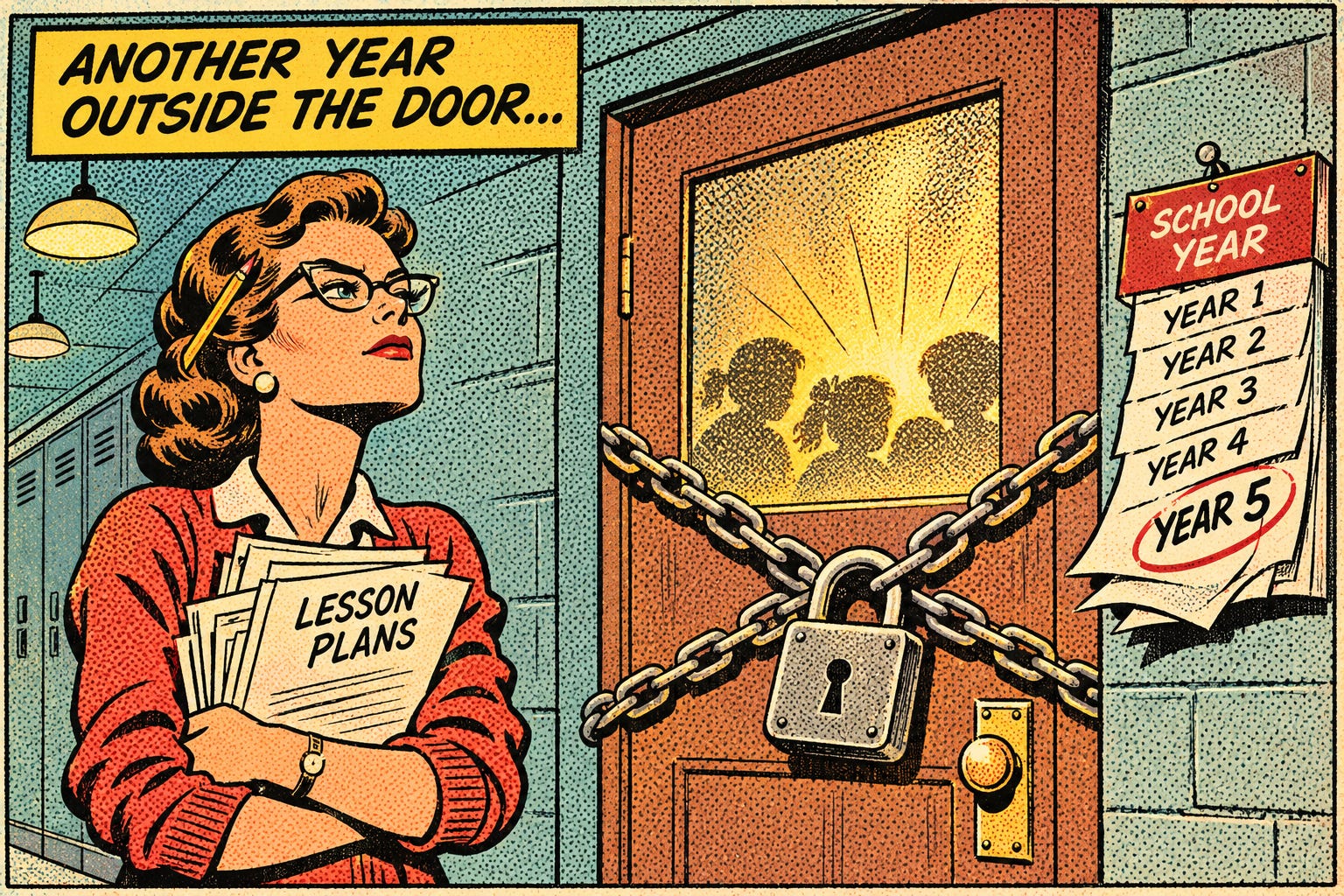
While we all grapple with AI, New York City Public Schools paused AI use for elementary and middle school students, and Los Angeles Unified restricted all students from using AI tools, both for the 2026-27 school year. I sympathize with these decisions, though I disagree with them.
There are three risks behind them. The first and most obvious is that we don't know what the impact on students will be, so “do no harm” comes to mind. A one-year ban will do fairly little harm while we get our facts straight. Second, public opinion about AI is negative and in flux. Districts that rely on public funding are therefore cautious, individually and collectively, and wait-and-see seems politically prudent. Finally, data breaches and privacy violations pose significant risks. From these perspectives, large districts banning AI seems a logical temporary (I hope) step.
Still, I think it is a short-sighted step. This post is about what we teach pre-service teachers at a time when educational technology is in flux.
What I Teach
This semester I am teaching Elementary Technology Integration, a class my students take fairly early in their program, as they begin professional practicum experiences in schools.
Teaching future teachers always involves a gap between what we teach them and what they see in schools. We have to be both present and future-oriented, and help them bridge what exists within current systems and imagine what the (best) future might be. That future is where their careers lie. They will graduate in two years and, hopefully, stay in the profession for 10 to 20 years.
This gap creates tension. Our preservice teachers are present-oriented for a good reason. That alignment makes sense as they want to get jobs in today’s schools. Our job is also to prepare them for the future, because they will teach and lead in future schools.
From my perspective, AI is one of those things we have to tackle head-on in a technology integration class, even if schools decide to ban it. My students point out they are not seeing AI use; I counter that we cannot know what will happen. These are one-year bans, and only in some places. Other districts are adopting AI fully, partially, only in high school, or for teachers only. There is a tapestry of options, but we do know AI seems here to stay, even if we don’t know the details.
One example is a task asking my students to create an assessment with and without AI, then compare the two. What did AI do well, and what did it not? How do effort and outcomes compare? They first experiment, compare, and finally reflect on the practical and the ethical boundaries of using AI in this way.
My preservice teachers need at least a sense of what AI is and what it can do right now, so they can start building mental structures for its ethical boundaries, its capacity boundaries, and how it might support their practice. At the teacher level, AI is a set of tools for producing instructional materials, building assessments, interpreting student work, and much more.
Once they understand AI, they can also start thinking about what they want to teach their own students about it, even in classrooms that do not use AI. We cannot ignore AI. It is a reality, and it is critically important that we engage with it as a topic.
We must do this because the gap between the real world (the world students experience outside the classroom) and the classroom is an unaccounted-for risk. The more students feel that the real world and the world of school are at odds, the less likely they are to take school seriously. They need to see alignment, alignment but not reflection.
A good analogy is civics education. We teach children about making democratic choices and how institutions work, even though they are not yet full participants in politics. They cannot vote. They cannot be elected. There is a whole host of things they cannot do, but they can still learn about them, so that as adults they are ready to participate.
I think about AI in much the same way. We have to teach students about AI because one day they will be full citizens in a society shaped by it. We want them to have the knowledge to participate in the discussions about AI, let alone use it in their everyday lives. For that to happen, their teachers have to be thinking about it now.
This is part of the challenge with bans. It is true that we worry about AI taking agency away from students, or making them think they know something they don’t because AI did their assignments. I accept that completely. It is a real risk, and we have to weigh it carefully.
At the same time, we have to teach preservice teachers how to use AI and start their thinking about how they might bring it into instruction “Do no harm” is a very real guide for that work. But harm can come from not acting as well. Bans just push the decision and action a year down line, but in wait of what? What clarity will we have next year?
The Challenge
The problem with bans is not that districts made a decision. It is that another year without AI in the classroom is another year when teachers don’t get to practice what is and isn’t appropriate, explore those boundaries, and find what works and what doesn’t.
This is where my world of research clashes with the world of classroom practice. This is one time when research cannot keep up with AI. AI is everywhere: it is in kids’ hands, in their homes, and on their phones. The faster we can get to best practices, the better.
Research is struggling to catch up because these realities shift so fast and the tools are already available to everyone. The research world, for better or worse, is not equipped to move at that pace. It is careful and deliberate, and it needs approvals from ethics committees, while the AI companies are running a major experiment on humanity. Research simply wasn’t designed for that.
I am not arguing that research should drop its ethical boundaries. It is just that these things are happening in parallel, and society, schools, and teachers are stuck in the middle, trying to figure out where these tools make sense and where they don’t, without the benefit of research. Performance, musical or otherwise, is part of the answer, part of the way we can evaluate impact.
What to Do Now?
When I return to my sister’s question about how to think about the future of education, whether in music, teacher education, or anything else, my first answer is that we, as teachers, have to keep exploring AI. What are the boundaries? For every aspect of our teaching, we have to ask whether AI is appropriate and how we might use it productively without risking the outcomes we want to see. Agency, cognitive growth, and grappling with hard problems have to be part of the picture, and no blanket yes-or-no policy can account for them.
This is my approach: look at each goal and each assignment, and ask whether this is a good place to use AI and what the boundaries should be.
They can do that only by experimenting. If teachers can’t use AI, they can’t experiment with it or try it out, and that is one more year lost. Even a one-year ban pushes that experimentation, and everything that comes of it, a year down the road. My sister and I will keep trying to figure it out, and if you are teaching in any capacity, formal or informal, so should you.

