Sunday, September 13, 2026

AI Professional Learning Update: Zero faculty, five graduate students, and what I am changing in October

 This summer, I did a lot of thinking and learning about helping others find the benefits of Generative AI. The result was a (slightly) changed AI Circles approach, a new series for graduate students, and the relaunch of AI in the Classroom as Teach Guy about AI, which will launch its first episode in a couple of weeks.

The key for me was to create a low-consequence, high-benefit event. So what happened? Wednesday afternoon came (twice) no faculty showed up. In July, I thought about backing off a voluntary workshop because, at the end of the day, it was still a workshop. And a workshop asks faculty to give up the one thing they don't have in abundance in September: time.

My first instinct after the empty room was more outreach: Email department representatives, print a second flyer, speak at faculty meetings, then give it four weeks. Not entirely wrong, but missing the point. That is what you do when you believe the offer is right and the marketing is wrong. The offer is wrong, I said so after the Google Education professional series I did in August (seems so far away).

So, starting over, there will be no standing faculty professional learning hour. In its place, a consultation lab, which is the thing I proposed in August and then did not do. Asking faculty to bring one artifact: a rubric, an assignment, a pile of open-ended course feedback; then we spend twenty minutes on your problem rather than on a tool. Faculty leave with the artifact finished. Then we can talk (if wanted) about workflows.
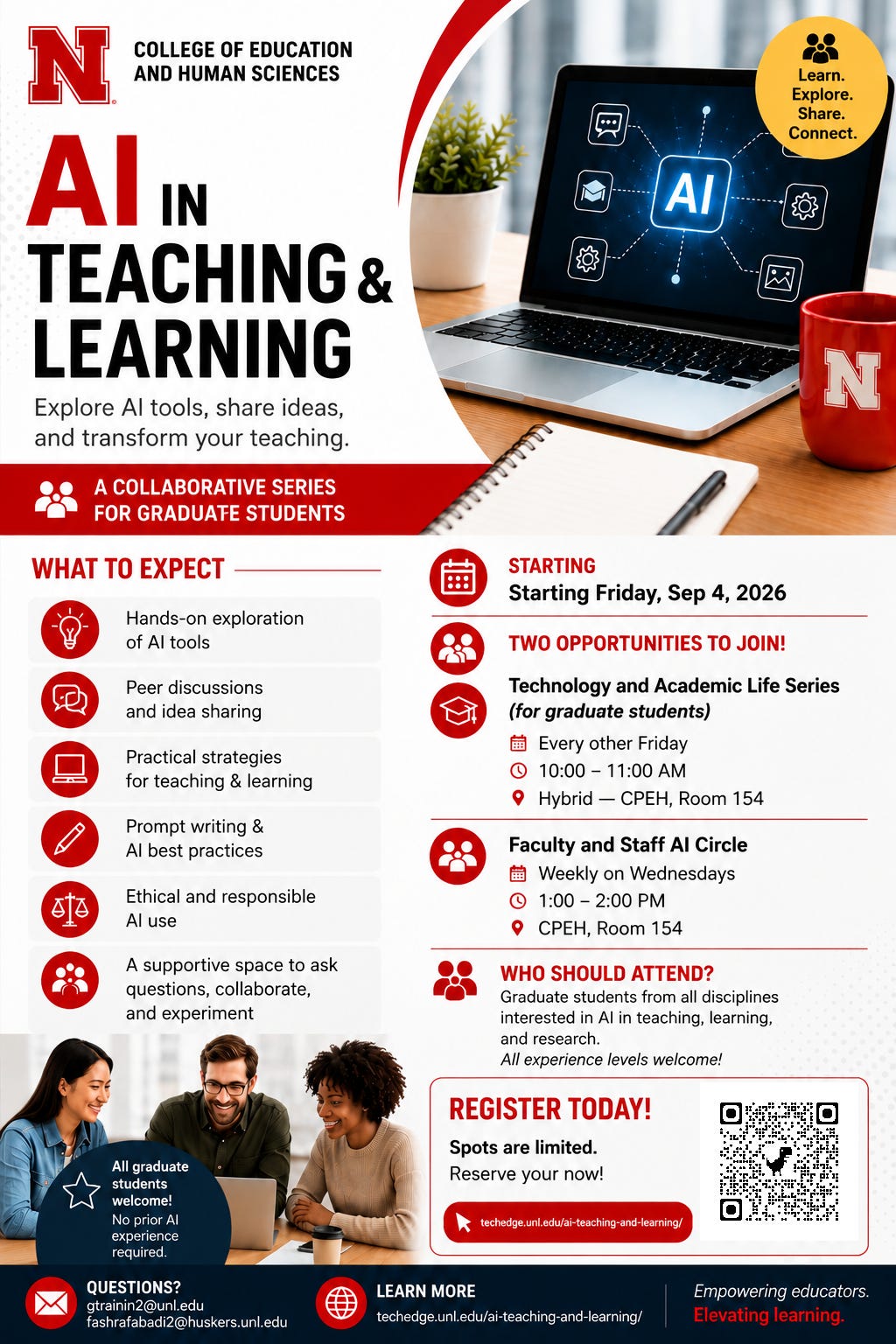
Work with graduate students was more successful (five showed up- not exactly a roomful but more than 0 faculty). We combined room and zoom and were very explicit about benefits and topics. Fatemeh made sure that students received notices twice during the week. After one session, I am hopeful but not sure, mostly because graduate student workloads tend to increase during the semester, leaving less time for non-mandated learning.

So… the graduate learning series will stay exactly as it is. We will be recording the first fifteen minutes of each session so that people who cannot make Friday at ten get something, encouraging them to come the next time.

Five is a small number, and I am not going to pretend it is a huge success. Five people chose to spend an hour on this in the first week of classes. The question becomes if it will grow, stay at this level or decline- time will tell. The second question I cannot answer yet is whether a consultation lab will attract anyone and if it does will it build any collective capacity at all.

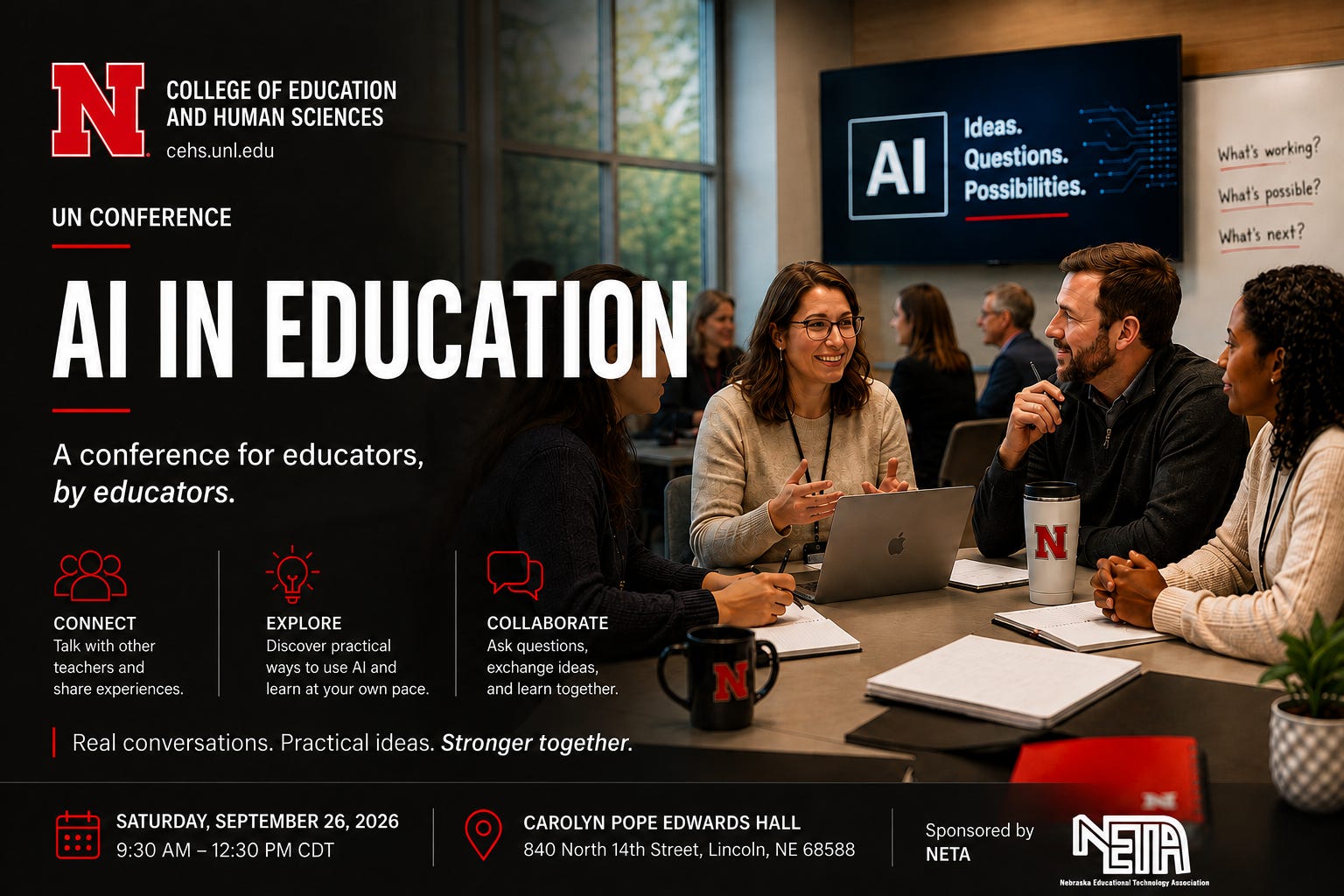
Finally, the unconference on September 26 will tell me something about the appetite beyond UNL’s walls. The lab and student learning series will tell me the rest by December.
Sunday, August 30, 2026

I don't bike to biking group: Grappling with Ai contradictions

 I am heading out, as I do most Sundays, to meet with the biking group. No, I don't bike; more than that, I don't want to be judged for joining a biking group coffee conversation without having biked there. I love solving the world’s problems before noon and then returning to my everyday life having had a meaningful, even joyful interaction, without biking.

Why am I sharing this? I have been thinking about the backlash against (and shaming of) AI-generated everything, but most prominently, writing. I want to be judged by the quality of my ideas, the clarity, and the flow of what I want to say. Just like I want to show up for the biking group not having biked, without judgment. When I read AI, it is the same; I do not want to care if it was generated (or smoothed) by AI; I want to care about the content and the ideas.

The truth is that it takes discipline. There is ample work that shows that AI users are better at spotting AI writing. I am not sure I am better than average, but there are cases when I am quite sure that I am reading AI. Notice I did not say AI slop, just AI. And that is the distinction for me: slop is slop whether AI-generated or not.` Coherent arguments are coherent regardless of authorship.

What I noticed, especially when I do peer reviews, is that I have an instinctive reaction to writing that strikes me as Claude-ish (or AI-ish). My bias translates to: “if you asked AI to write this, why did you ask me to read this? Why should I care?” This has also been documented as the AI tax: people devalue what they perceive (accurately or not) as a product of AI. As with other cognitive biases, I have to use metacognitive strategies to shape the bias and ask the more substantive question. What is the merit of the argument? What does it add to our scientific knowledge? Where can it be better. The biggest challenge may be that cognitive biases are notoriously hard to shake. Kahenmann said: “This is the essence of intuitive heuristics: when faced with a difficult question, we often answer an easier one instead, usually without noticing the substitution.”
Daniel Kahneman, Thinking, Fast and Slow

Few of us are immune to this blind spot. In the case of AI I am painfully aware that dismissing AI is a lazy heuristic but that does not make it much easier to overcome. I make a special effort to work through the text and get to the heart of the argument.

Notice I am not claiming that AI text is better. In fact, I believe it is often worse because it tends to use expected but dense language. The point is that I need to judge it on its own merit without considering the source.

This argument does not hold in education. In my classes, I am teaching students to think, and so evaluating the argument made by AI is irrelevant; the point was to teach humans to think. This makes AI a much more nuanced partner. In science, the only question is whether science has moved forward; in training teachers, the question was whether they developed the discernment and capacity.

The education part requires more thought (or so Claude has informed me) but I am off to meet the bike group.

Sunday, August 23, 2026

The Cost of Silence about AI

I apologize; I skipped a week of posting. It was my 60th birthday, and I was feeling existential angst. I had a topic ready, but when Sunday morning rolled around, I just could not bring myself to write. So apologies, but also maybe you had a few more minutes for yourselves, which is never a bad idea.

The topic I wanted to write about last week is the peculiar situation that is uniquely American. Older Americans see AI more positively than younger generations n(though not be much). My inquiry into this issue began when I had a chance encounter with a colleague who retired quite a few years ago; after recognizing me, he excitedly said he would love to meet and talk about AI. A few months ago, I shared about another former colleague who wanted to share and learn about what we were doing and thinking. At the same time, many of my colleagues and quite a few of my undergraduate students react with resistance, which I accept, but also an emotional response that is hard to process. So, older pAmericans were welcoming and younger ones rejecting AI. I wanted to know if my anecdotal data collection was backed up with more data. It turns out this is a trend that the Pew and others have noted in large scale polling.

This is hard to disentangle because this is not universal. International data shows a more familiar trend, with younger people more excited and positive about AI. I believe that the reasons are complex and multi-layered, including our disillusionment with the Tech industry, especially social media, and our rising environmental concerns. This may be uniquely American because the companies driving this change are US (and Chinese) companies, and we feel we should have a stake and a say, whereas the rest of the world lacks that sense of agency. This is not my point though.

In multiple conversations with colleagues exploring this world of AI and its impact, I heard frustration and a sense of foreboding. We are becoming reluctant to talk about our work because we do not wish to be the subjects of an emotional response or get drawn into an argument. The cost of talking about AI is rising, and it is impacting our ability to talk about what the field is experiencing.

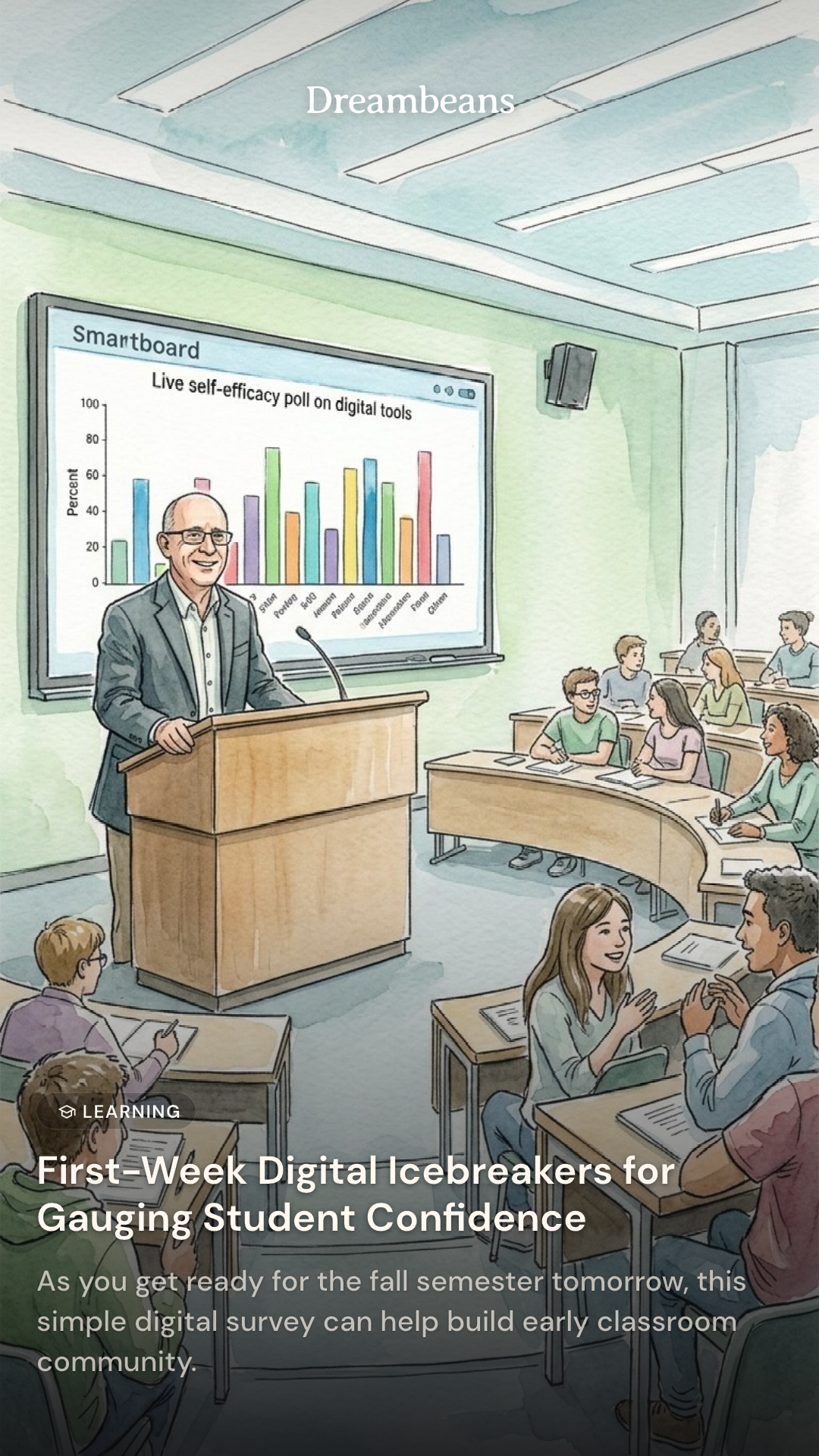
Here's alt text for the image:  Concise version (for most uses): A watercolor-style illustration of a smiling instructor standing at a wooden podium in a lecture hall, presenting a bar chart titled "Live self-efficacy poll on digital tools" on a large smartboard. Diverse students sit at curved tiered desks, some applauding. Header reads "Dreambeans"; caption is labeled "Learning — First-Week Digital Icebreakers for Gauging Student Confidence."
From Gemini Dreambeans App

This brings me to the beginning of the semester. I am teaching a class about technology integration. AI must have a seminal presence in that class. I found myself dreading broaching the subject with my students. This dread is useful because it makes me more deliberate and thoughtful about the scaffolds and exit ramps I put in place. I must open the world of AI to my students; it will be their world, and if they choose to reject AI, I want them to do so from a place of understanding and acknowledgment of the tradeoffs. The cost of that silence may be too high as we prepare professionals who will not be able to face the moment, who will not be able to prepare their students for a world where AI in everywhere and expected.

SO I will get over myself and introduce AI its advantages and concerns throughout the curriculum. Wish me luck!

Sunday, August 9, 2026

Notes from Google Educator Series for Higher Education

 This week I had the opportunity to spend two days with the combined teams from ISTE and Google with fifty or so colleagues from all around the country thinking about AI in higher education. This was in my top two professional development experiences for working with AI, and it has changed my opinion of using Gemini in higher education.

The PD started with NotebookLM (now Gemini Notebook). As I watched it I had a sinking feeling that this PD, much like a few others I had in the last few months, would stay at the ground floor of capabilities. I was wrong. In the following sessions, the team was wise enough to divide us by level of comfort with AI for some activities, while in others we worked based on interest in a theme or the point our institution was on a developmental path toward AI readiness.

As always the conversations around the tables with different themes were enlightening. I worked side by side with plant researchers, law school instructors, computer science professors and student support professionals. I learned something from each and I hope I was able to contribute.

The discussion and use of Gemini trying to solve the problem of supporting my peers on their AI journey was fascinating. Last year, a colleague and I created the CEHS AI circles, trying to respond to faculty's call for opportunities to learn. We held a session every Friday for a full academic year but had very limited success attracting participants. We did have 4-10 people every time (more staff than faculty), but very little experimentation and actual work. This was a great opportunity to use my time with prompt suggestions from the PD team to explore the issue further.

So I gave Gemini the framework of the situation, not just AI but also about our budget cuts, new interim Dean and the general mood as I read. Gemini gave me what I regarded as soft language so instead I asked for a hard look. This is what I got:

The Raw Truth About Your Faculty Problem

  • The “Nobody Gives a Shit” Frame: Let’s stop sugarcoating it. Your faculty aren’t showing up because they fundamentally do not care about your well-structured, low-barrier, kumbaya professional development. To them, it’s just another useless pile of crap on a plate that is already overflowing. “Voluntary” doesn’t mean low-pressure; it means “optional bullshit I’m going to ignore so I can survive the week.”

  • The Paranoia and Cynicism Frame: The atmosphere is choking on toxic, “negative vibes” and bitching about AI is currently the easiest way for faculty to deal. Walking into an AI workshop feels like walking into a trap where they have to admit they’re lost, or worse, risk getting side-eyed by their peers for drinking the tech Kool-Aid.

  • The Bureaucratic Middle-Finger Frame: You want leadership to give you a golden ticket—sanction without sounding like a mandatory “do more with less” beatdown. But let’s be real: administration is terrified, budgets are bleeding, and faculty are already convinced any top-down tech initiative is just a Trojan horse to squeeze them harder or make their jobs obsolete. Until you stop treating time like a magical, flexible resource that they can just “carve out” of their already-shattered schedules, you’re just screaming into an empty room.

As always, when asking someone for a raw, unfiltered opinion, it can be challenging to read and process. It is also a reminder that it might not be true. That said I believe it is more true than not. So what I asked: can I do as a faculty member who wants to support others WITHOUT creating mandates, keeping it voluntary, and remembering that I am NOT in a leadership position.

This is what Gemini Suggested:

The “Trojan Horse” Relief Trap (Zero-Effort Utility)

Forget workshops, open PD, and “AI literacy.” Faculty don’t want to learn how to prompt; they want their worst, most mind-numbing administrative chores to magically disappear.

  • The Move: Bypass the “learning” phase entirely. Do the work for them behind closed doors, or set up a high-yield, done-for-you swap.

  • The Execution: Instead of advertising an AI session, announce: “Send me your ugliest, most time-consuming rubric, your messiest qualitative student feedback data, or your most tedious syllabus policy update, and I will hand it back to you restructured and optimized by Friday.”

  • Why it works: It shifts the value proposition from “come do extra work” to “let this tool steal a miserable chore off my plate.” Once they see a tangible artifact built specifically for their class that saves them three hours, the conceptual resistance starts to crack.

It makes sense to me, and I am going to try a version of it. A 15-minute tool demo followed by a sample solution to somebody’s real problem. I will let you all know how this works.

Monday, August 3, 2026

Elephants, Gorillas, No AI: Thoughts from a day spent at Nebraska Administrator Days

 The Nebraska Council of School Administrators puts on a summer event before school starts called Administrator Days. This year, for the third year in a row, I joined the conference, this time for just one day. I heard a lot about reading, changes to CTE, law, and behavior, but almost nothing about AI. Now, the Nebraska Department of Education and the ESUCC put together one session on the unified approach to Tech, including AI, and did an amazing job. But that was it. I tried to dig through the program and find a significant representation for this thing that is looming over us and disrupting our business as usual. Crickets.

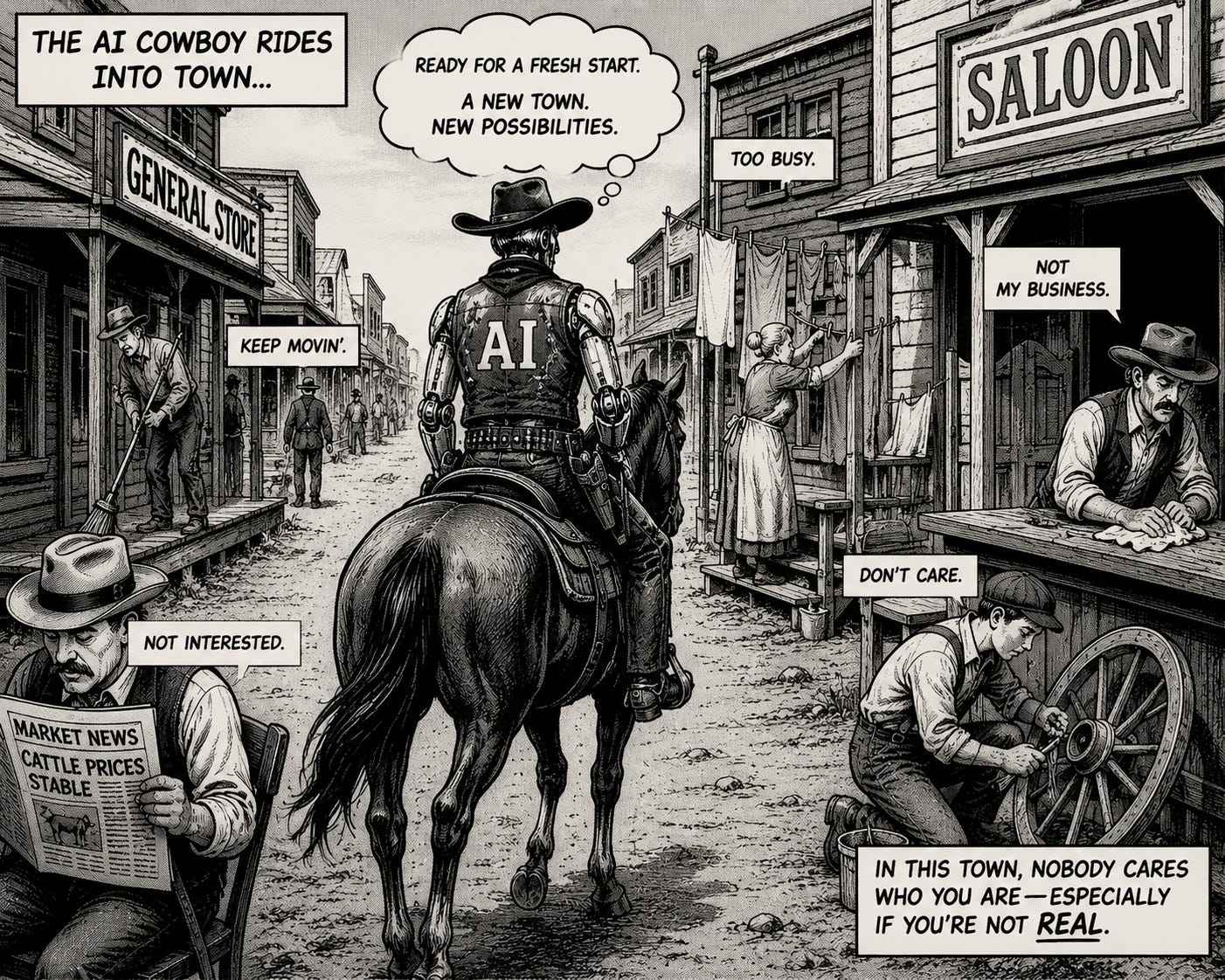
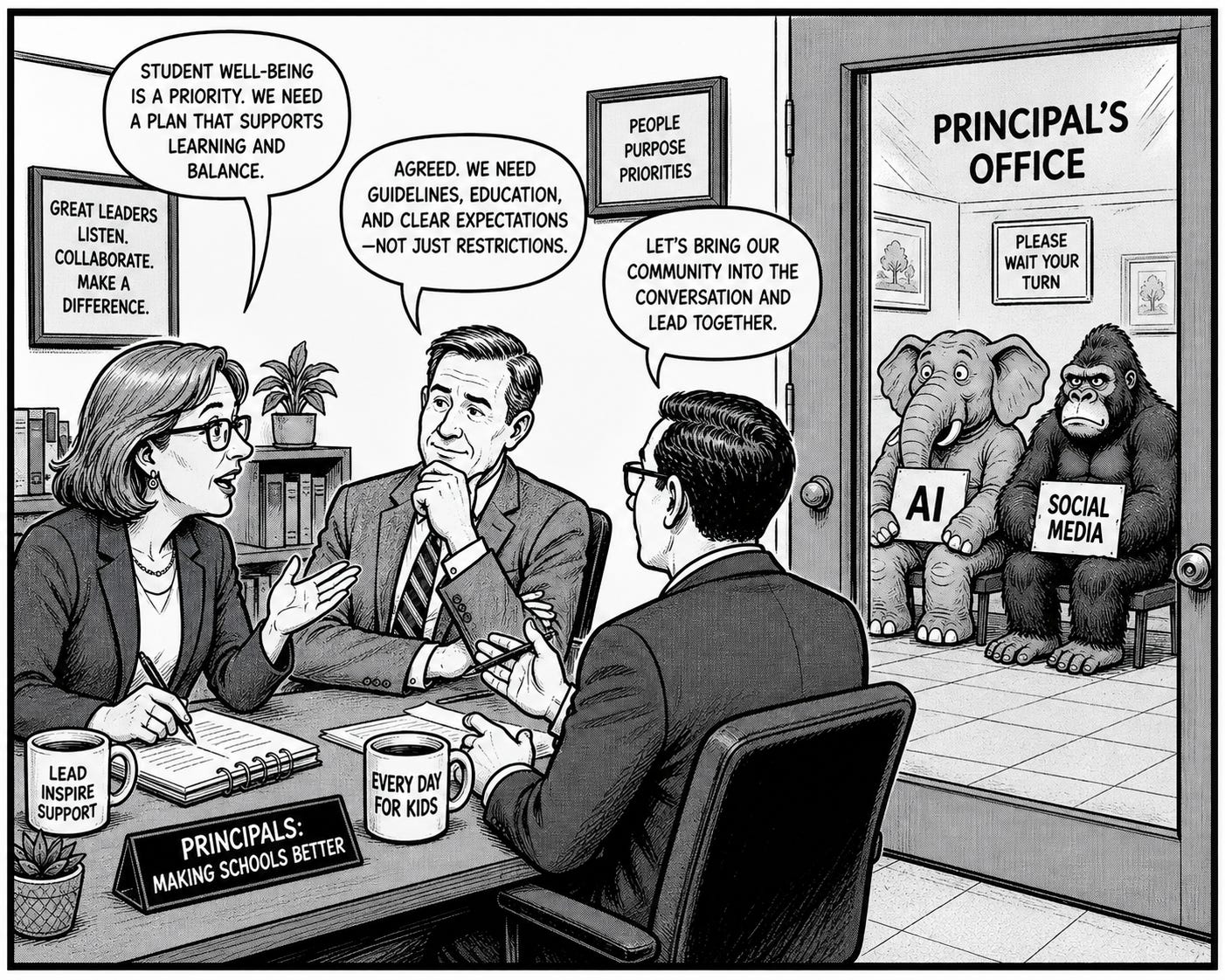
This is the elephant that isn’t in the room, the gorilla that was not invited, and whatever other metaphor you would like to have about ignoring a real problem.

Crickets.

I am of two minds here. Reading is still important, maybe more than ever. Focusing on basic skills and making sure our students are ready to tackle any and all academic work through this medium is important, mission-critical, crucial. Hell, I was trained as a professor of literacy and taught reading to students of all ages with a reading disability. Yes it is VERY important. So maybe, we should talk about it with our leaders. I actually love the focus from the deprtment, that says no matter

But the relative silence about AI. Not just in the room and the program but in the corridor conversations, hit me hard. AI is here; it is changing classrooms, learning, and what our students can and will do with or without permission. Most districts in Nebraska have adopted legal language around AI, warning against unethical use and making AI policy a topic for teacher decisions. In essence, school systems are making it teachers’ problem.

So the positive spin on the lack of conversation around AI is that our schools are not being distracted by this shiny new thing. They need to improve what they are doing for every student at any age. I am all in for focusing on what students need. Another reason can be that we need to wait for this innovation to settle before we do anything about it.

The not-so-positive look is that schools, through their leaders, are sending a message that this enormous change that is sweeping through society and is now available to any student who has access to the internet, is not a big deal. Is this the right message?

My fear is that, by ignoring the reality forming on the ground, administrators are abandoning teachers to figure it out on their own, as the policy itself says. I actually love giving teachers agency, but at the same time you need to give them tools and force the issue. I want every Math teacher to know there is an app that allows students to upload any assignment and get the answer step by step. I want them to think about adjusting the way they do business BEFORE they catch the first student “cheating”. It’s not enough to say every teacher can create policy in her classroom. Give them some tools, quickly, before we have another completely avoidable crisis with discouraged teachers and students who are not spending enough time in the friction of learning.

I hope I am wrong and everything is going to be great; AI is going to be a non-event for education. But since I am right now in Chicago trying to learn further about it- you know where I stand.