Showing posts with label computer science education. Show all posts

Sunday, June 14, 2026

The Tinkering Ways AI is Transforming Research

 I recently sat on a grant panel. As on many panels, I was asked not to discuss the details of the decisions, a request I always respect. The proposals spanned a wide variety of fields, so there was plenty to learn and chew on. What struck me most was the robust use of AI.

Well, you’d say, we live in the age of AI. Everybody’s got ChatGPT (or pick your favorite model), and people mumble something about how it can be used because generative AI is sexy and new. The cynic would point out that we’re saturated with AI, both as an economic and a cultural phenomenon, and that if you want funding, you have to at least nod toward some magical use of AI that will completely transform your field. The cynic would add that in most cases, the AI is described vaguely and hand-wavily. And they wouldn’t be entirely wrong.

But in many of these applications, I saw something else entirely. Most of them actually included well-thought-out machine learning, not generative AI. They used small models, built from scratch for a specific purpose, as opposed to large language models. In a way, these proposals were “unsexy”: they didn’t reach for the new models at all. They offered innovative solutions using the old ones.
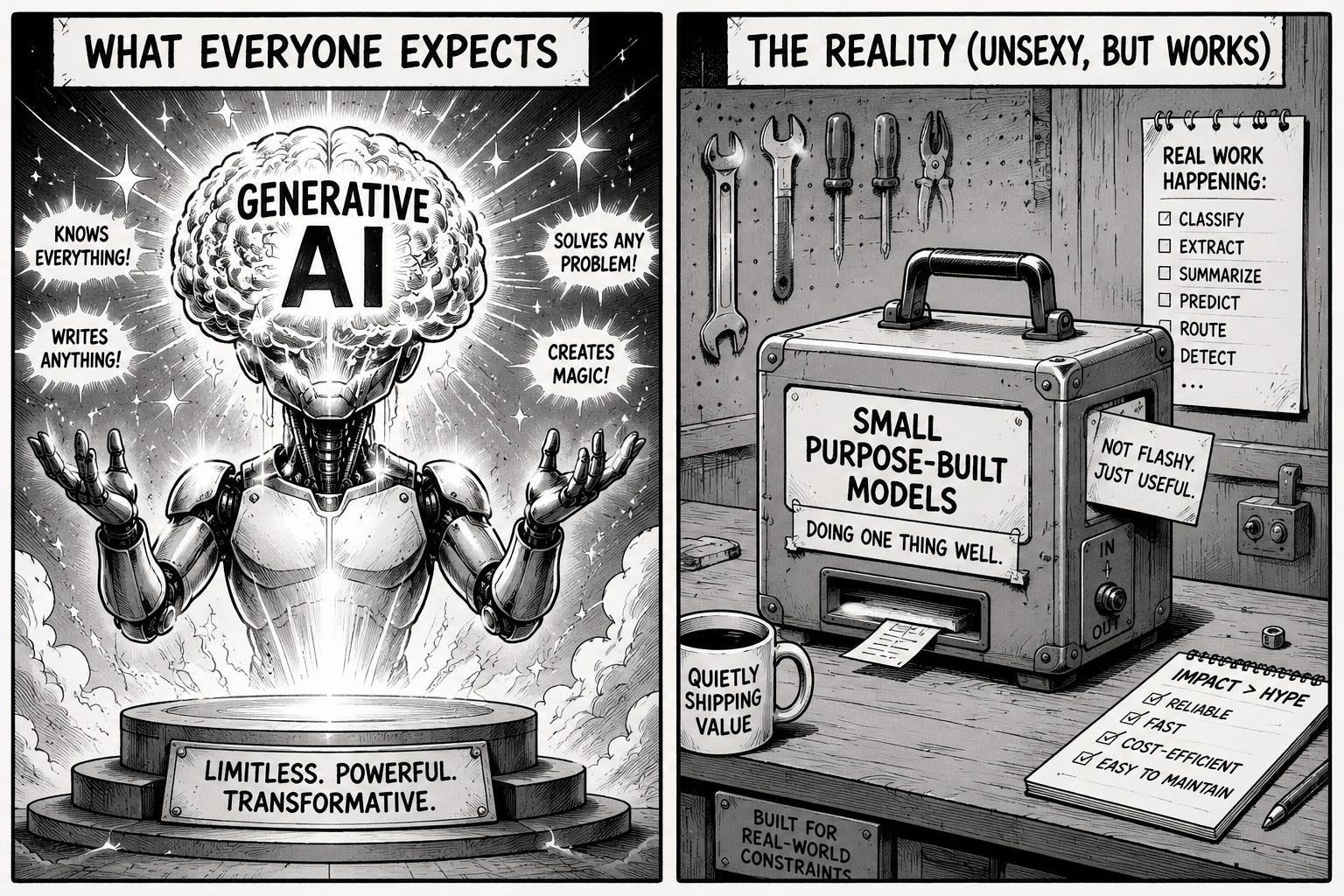
Black-and-white two-panel comic contrasting AI hype with practical AI use. The left panel, labeled “What everyone expects,” shows a glowing futuristic robot with a brain labeled “Generative AI,” surrounded by sparkles and exaggerated promises like “knows everything” and “solves any problem.” The right panel, labeled “The reality (unsexy, but works),” shows a plain toolbox-like machine labeled “small purpose-built models” quietly completing useful tasks such as classifying, extracting, summarizing, predicting, routing, and detecting.
Created with ChatGPT 5.5

The insight took a few days to land. AI was everywhere, but not in the cynical way I’d expected. Here’s how I read it: the cultural significance of generative AI, and the sheer accessibility of AI, has gotten researchers in every domain thinking, “Hey, maybe this AI thing can help me solve this really hard problem.” (Sorry, I can’t reveal much from the panel, so no details.) It’s fairly clear to me that generative AI has started a conversation inside research that will produce exciting new solutions to some of our most intractable problems.

The next challenge, oddly, will be having enough compute, coders, and AI experts to bring these projects to fruition. I saw this at one of our research gatherings earlier this year: everyone is looking for an AI research partner, while our AI scientists are flooded with collaboration requests. I think we could triple the number of people doing that work and still have demand to spare.

So where does that leave us? I believe research universities should invest in compute and AI know-how as a shared service that can support many research efforts at once. Some have already gone this direction. I hope more, including UNL, will follow.

Friday, March 29, 2024

Leaving Las Vegas thinking about Computer Science Education

The SITE conference was in Las Vegas this year. It was great to connect with old friends and find new ones. While on the plane home, I want to reflect on what I learned before the hubbub of teaching and my next conference arrives. 
What did I see? I chose to focus on the work being done in Computer Science. The panel put together by Chrystalla Mouza was especially excellent. The panel had a great discussion of strategies and challenges in recruiting and retaining teachers for CS. The metaphor I settled on was the blanket that is too small. If a specific district is able to "recruit" from another school system, the problem does not get solved. It just changes location. The same can be said if we transition Math or science teachers. The three strategies that emerged were:
1. Recruit internally from areas that have a enough teachers (e.g. art, Media, English or Social Studies). For this to be successful the professional learning has to be different and address ways of thinking and projects of interest that would fit different thinkers within their domain expertise.
2. Make it part of a general campaign to go into teaching. 
3. Focus on second career/ career changers. Here there is a need for short programs and funding during the process of changing career.

The second strand was TPACK which after over 15 years of research is still one of the most often used frameworks. Punya Mishra led a series of presentations sharing the work done on the third handbook of TPACK research soon to come out. The work was varied and interesting and the variety of approaches, measurements and direction was extensive. 

Finally, and unsurprisingly there was discussion and grappling with AI everywhere I went. AI is changing everything including education in ways that we do not fully understand, but researchers from around the world are trying to apply what we learned from previous critical moments (advent of personal computing, internet, social media). 

Tuesday, March 5, 2024

Motivation for Tech Careers a Reflection

boy playing with early computer
I have loved science fiction for as long as I can remember. I have a vague memory of going to the neighborhood bookstore Doron and purchasing my first book, Asimov's Foundation. Science fiction primed me to be incredibly curious about computers. Four years later, my father went on sabbatical to Boston and we all came with. In the summer of 1982 we landed in Newton Massachusetts. For the first two months, we lived in the house of the Alroys, who were spending the summer in Switzerland. This part is unclear to me but their neighbour and friend a mathematician asked for help watering the plants and in return he let me use the Atari 400 (in today's dollars a $2000 investment). I remember my utter delight in programming simple Basic programs I learned to create. It started a life-long obsession with technology and that first encounter with a well designed technology and the delight in what it could never really went away.

Atari 400 computer
Reading Kara Swisher's memoir/ history/ critique of Silicone Valley and the big tech companies it feels like I was not the only one. A whole generation of us on the dividing line between the baby boom and Generation X grew up and matured with the tech industry and loved it deeply. I am wondering if the generation emerging now has that sense about any technology? As we work hard to get students excited about technology I am finding that the sense of wonder and excitement is rarely there. Have we become less optimistic? Do they need to feel that they are rising up with new ideas (say AI, for example)? To better recruit teachers and students and increase diversity in tech, we must understand what motivates them and what they most like to be part of. At the same time, we must think about ways to get them excited and feel that they are at the beginning of something great.